
Blog
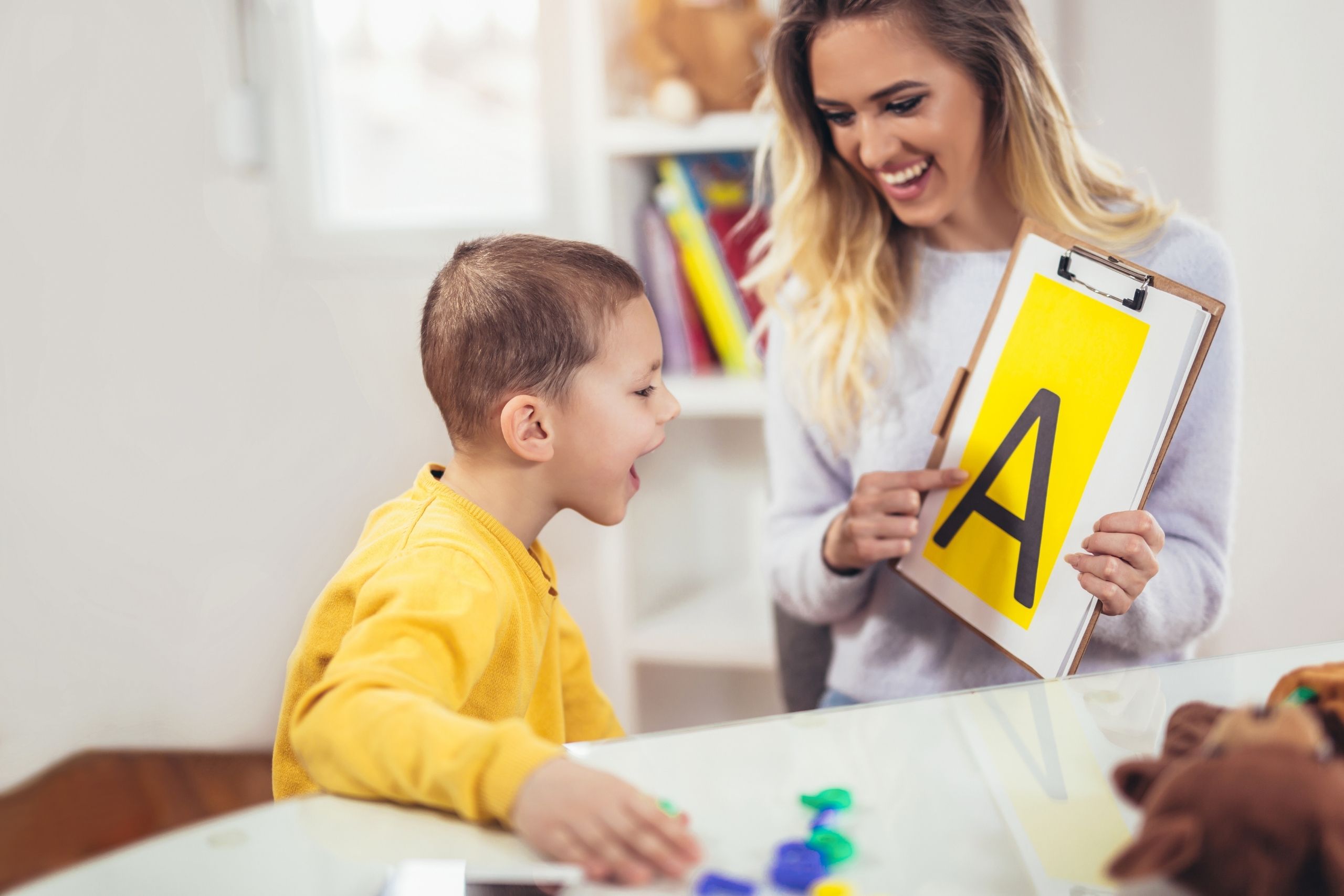
Florida Speech-Language Pathologists are in High Demand
Florida speech-language pathologists are in high-demand – at our Southwest Florida pediatric therapy clinic and elsewhere. Speech-language pathology (SLP) ranks as one of the most desirable – and fulfilling – careers out there. Not only do these professionals enjoy significant job stability, good compensation, and numerous opportunities for career advancement, they have a direct role in the tangible well-being of their patients – and that’s truly why most of us are drawn to this field.
We know that at FOCUS Therapy, watching a pediatric speech therapy session can seem a bit like you’re watching play time. (And don’t get us wrong – we do have A LOT of fun!) But there is actually a great deal of study and consideration that goes into tailoring each session to help the individual child reach their goals.
We find that for parents, it’s helpful to know exactly the kind of training and dedication these professionals take on to get to the point of being able to structure play-based therapy (the kind we find most effective when working with children).
What Exactly Do Florida Speech-Language Pathologists Do?
Speech-language pathologists are experts in communication, and can actually work with people of ages – from infants to the elderly. They treat many different kinds of issues related to communication and swallowing. Some of these include:
- Speech sounds. This is how we say sounds and put sounds together to form words. We sometimes refer to these as articulation or phonological disorders. They can also include dysarthria and apraxia of speech.
- Language. This is how well we understand what we hear or read and how we use words to tell others what we’re thinking. With adults, this is referred to as aphasia.
- Literacy. This refers to how well someone is able to read and write. Lots of people (especially children) with speech & language disorders may also have trouble reading, writing, and spelling.
- Social communication. This is how well someone is able to follow social rules, like talking to different people, how close you should stand to someone when you’re talking, and how to take turns in a conversation. Formally, this is referred to as pragmatics.
- Voice. This is how a voice sounds. One might talk through their nose, speak too loudly, lose their voice easily, sound hoarse, or struggle/be unable to make sounds at all.
- Fluency. Most people know this as “stuttering,” and it refers to how well speech flows. Lots of young children stutter, but many grow out of it. Those with persistent issues should consult with an SLP.
- Feeding and swallowing. This involves how a person chews, sucks, and swallows liquid and food. Poor nutrition can cause a host of health problems. Southwest Florida speech-language pathologists can help.
- Cognitive communication. A deficit in this area would involve problems with organization, attention, memory, problem-solving and other thinking skills.
 You can find speech-language pathologists in private pediatric practices like FOCUS Therapy, but they’re also employable at schools, hospitals, doctors’ offices, rehabilitation clinics, and colleges/universities.
Steps to Becoming an SLP
The basic steps to becoming a speech-language pathologist in Florida are:
- Earning your bachelor’s degree in a related field. This is a four-year commitment. Two undergraduate degrees that many SLPs commonly earn are a Bachelor of Science in Communication Sciences and Disorders and a Bachelor of Science in Speech-Language Pathology and Audiology. These are ideal if you know early on you want to become a speech-language pathologist. But it’s not uncommon for people to switch majors a few years in. Other bachelor’s degrees that can be well-suited to a later career in speech-language pathology are education, linguistics, and psychology (particularly if you pair them with a minor in something like communication sciences and disorders.

Snow in Fort Myers? Check Out This Cool Occupational Therapy Activity!
South Florida may not have real snow like our northern neighbors (though there was that one time back in 1977), but this cool occupational therapy activity for kids is just as fun – no scarves or mittens required! 
Making fake snow is an excellent tactile activity that’s great for helping our pediatric OT patients practice important life skills. Kids can help with the scooping, measuring, pouring, and mixing ingredients – all of which helps with reach, grasp, and wrist rotation. It’s also great sensory engagement that can be tailored to help with critical thinking, social skills, and communication.
We opted to try it in a couple of our recent OT teletherapy sessions, but it’s easily replicated at our Fort Myers therapy clinics. We encourage parents to try it out at home for maximum carryover of important skills.
The cheap, easy-to-find ingredients needed for this faux snow craft are:
- Baking soda
- White hair conditioner
- A bowl or bin
- Some tin foil or newspaper to lay down (if you’re doing the project indoors)
Directions: Simply mix about 3 cups of baking soda with about 1/2 cup of white hair conditioner until it’s firm. (If you don’t have that much of either ingredient, just make sure you’re using quite a bit more of the dry baking soda than wet hair conditioner.) You can use a spoon or spatula, but we opted for the extra sensory input of mixing it by hand.
 Note that measurements don’t need to be exact. In fact, it might even help your child exercise their executive function skills if you don’t exactly measure it all out.
“Let your child problem-solve by determining if they need to add more wet or dry ingredients to the batch,” said FOCUS Occupational Therapist Krystle Lopez. “You’ll know the snow is mixed correctly when you can pick it up and form snowballs. It will even be cool to the touch – just like real snow!”
It will last a while too if you put it in a sealed bag or bin.
Be prepared for a bit of mess – but a ton of fun!
How Making Fake Snow Helps With Pediatric Occupational Therapy Goals
 “It’s amazing how many skills can be targeted just with this simple ‘play’ activity,” Lopez said. “And I love that it’s something simple parents can do at home as well.”
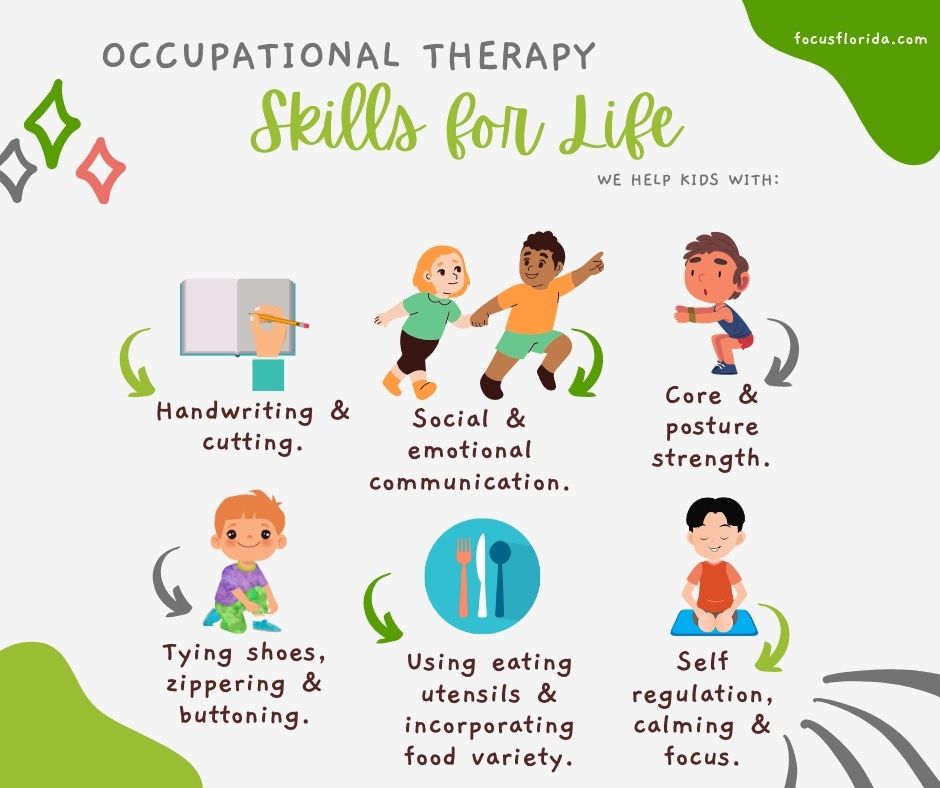
How Fort Myers Occupational Therapy Helps Kids
Occupational therapy is a broad discipline. Some parents are confused when they’re referred to “OT” by their child’s pediatrician. After all, the first thing that comes to mind when we think “occupation” is “job.” And kids don’t have jobs… Right?
In fact, children are tasked with a dizzying number of important jobs, spanning far beyond just learning to talk and walk (which in themselves can be pretty daunting milestones, especially for children with certain delays, disorders, and different abilities).
Occupational therapists – particularly those who work in pediatrics (with kids) – are responsible to:
- Identify the developmental/functional deficits with which a child struggles.
- Develop an evidence-based plan of care that specifically outlines the goals for each individual child on a personalized timeline.
- Use each OT session to creatively to help kids “play their way” to achieving those goals.
A pediatric OT session may look a lot like goofing off (another reason the field – and its necessity – are met with confusion). But the play-based approach is deliberate. You know the saying, “Time flies when you’re having fun”? Play is what keeps kids engaged and interested, motivated and willing to push themselves just a bit harder every time. The most effective occupational therapy sessions are those that don’t feel like work at all for the child. This is rooted in mountains of evidence showing that it works.

How Behavior Chaining Works in ABA Therapy
ABA therapy, short for applied behavior analysis or behavior therapy, focuses on studying behaviors – understanding them – and then incorporating techniques that promote expected behaviors and modify unexpected behaviors. One of the strategies our Fort Myers ABA therapy team employs is called “chaining.”
Chaining is a type of evidence-based technique that we can use to teach kids basic skills like handwashing or waiting their turn to more independent life skills.
The basic idea is that you’re breaking down each task into a series of mini-tasks. Many of us take for granted that skills like using the restroom or engaging in a conversation require numerous steps. We don’t give a second thought to every single step needed to complete everyday tasks – but there are, in fact, many. It takes some kids with developmental delays and disorders lots of practice to master each individual step.
Let’s take handwashing, for instance. It’s considered a single, simple task. But in ABA therapy, we recognize that there are many smaller steps to it. We break it down into little, teachable bits. These include:
- Turning on the sink.
- Adjusting the water temperature.
- Getting your hands wet.
- Pressing the soap dispenser (or grabbing the soap).
- Moving the soap around in your hands.
- Scrubbing your hands.
- Rinsing off the soap.
- Turning off the water.
- Drying your hands.
We teach this series of tasks as one “behavior chain.” Once they have the first step down, we move onto the next step in the behavior chain. As the child gets comfortable with each “mini-task,” we add or “chain” new behaviors/tasks that are linked to it, so that it all becomes synched. The child learns what is expected – and what is not expected – as they move through the steps of each task.

How We Use Storytelling in Fort Myers Speech Therapy
From fables and fairytales to silly rhymes and serious plots, kids LOVE story time! At its core, storytelling is about connection and communication. Everyone has a story to tell, and stories help us to understand the world around us and empathize with the people in it. Being able to follow – and tell – a story helps to understand the actions and opinions of others, and allows others to understand us too. Stories can be poignant and meaningful, giving us insight into an important life lessons, or they can be simple, everyday conversations, such as what someone did that weekend. When children learn how to tell stories, they learn how to be better communicators. At our FOCUS Fort Myers speech therapy clinic, we love using creative stories in sessions. It not only teaches children important communication skills, it keeps them interested and engaged!
Teaching storytelling involves not just reading stories, but breaking them down into the most basic parts for kids to understand. In our experience with young children, it’s best to start with simple narrative stories and then help them to identify the beginning, middle, and end. We teach them the transition words (first, then, next, last…). Even if retelling the story is difficult, sparse, or choppy at first, the idea is to help ensure the retelling isn’t random – it’s an organized beginning-middle-end structure.
For instance, we’d tell the story of the Three Little Pigs like this:
- First, three little pigs built three houses.
- Then, a big, bad wolf said he would blow their houses down.
- Finally, the three pigs found safety in the house made of bricks.
Once they’ve mastered this basic Beginning, Middle, End, we can help them work on the more complicated story structures, such as orientation/setting (answering the who, where and when questions), the complication/plot (answering the what questions), the action (this answers the what and also how), the resolution (also the what and how questions) and the ending.
No doubt these are skills your child will need in school. The sooner we begin working on it when they’re younger, the better.
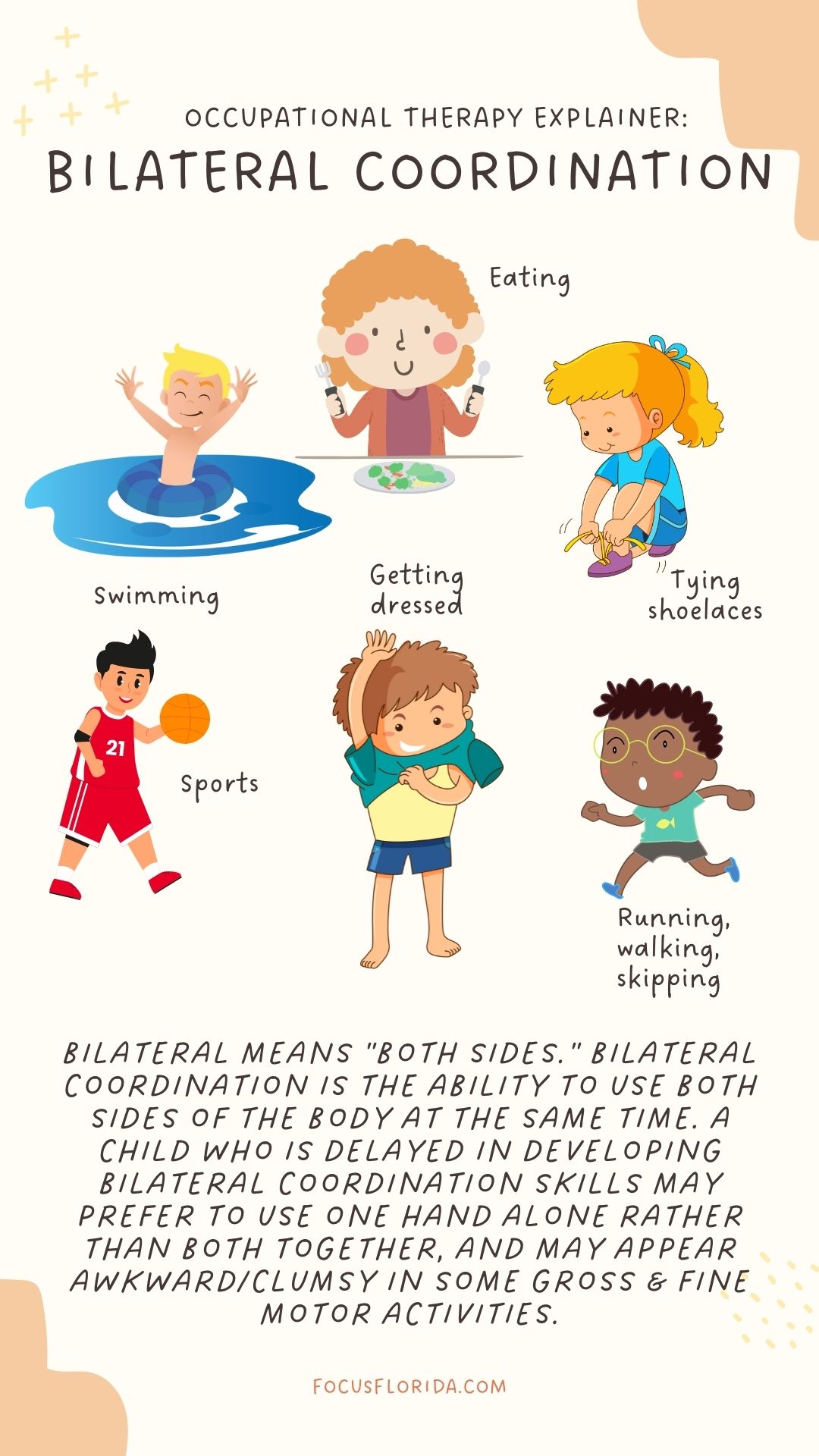
Bilateral Coordination, Explained by Fort Myers Pediatric Occupational Therapists
Bilateral coordination, sometimes referred to as bilateral integration, is a critical developmental skill with which some kids struggle. It involves using both sides of the body together, and can impact both fine and gross motor skills Children who have difficulty with bilateral coordination may be diagnosed solely with developmental coordination disorder, but it’s also closely associated with other conditions such as autism spectrum disorder, Down syndrome, cerebral palsy and other developmental delays and disorders.
As Fort Myers pediatric occupational therapists, we recognize there’s been an increasing awareness about what bilateral coordination is as well as what deficits might look like. A reported uptick in bilateral coordination deficits could also be partially attributed to COVID closures, as lots of kids lacked regular exposure to certain activities (PE class, playground time, etc.) that can help build these skills.
How Do I Know If My Child Has Poor Bilateral Coordination?
Some indicators of poor bilateral coordination include:
- Trouble cutting with scissors.
- Struggles with handwriting.
- Difficulty tying shoes.
- Having a hard time dressing themselves (pulling on socks, pants, and shoes).
- Trouble with fasteners, like buttons, zips, or snaps.
- Clumsy movements.
- Trouble catching a ball.
- Awkward clapping.
- Troubling using a bicycle pedal.
Parents should note there are actually three different types of bilateral coordination: Symmetrical, reciprocal and leading/supporting.
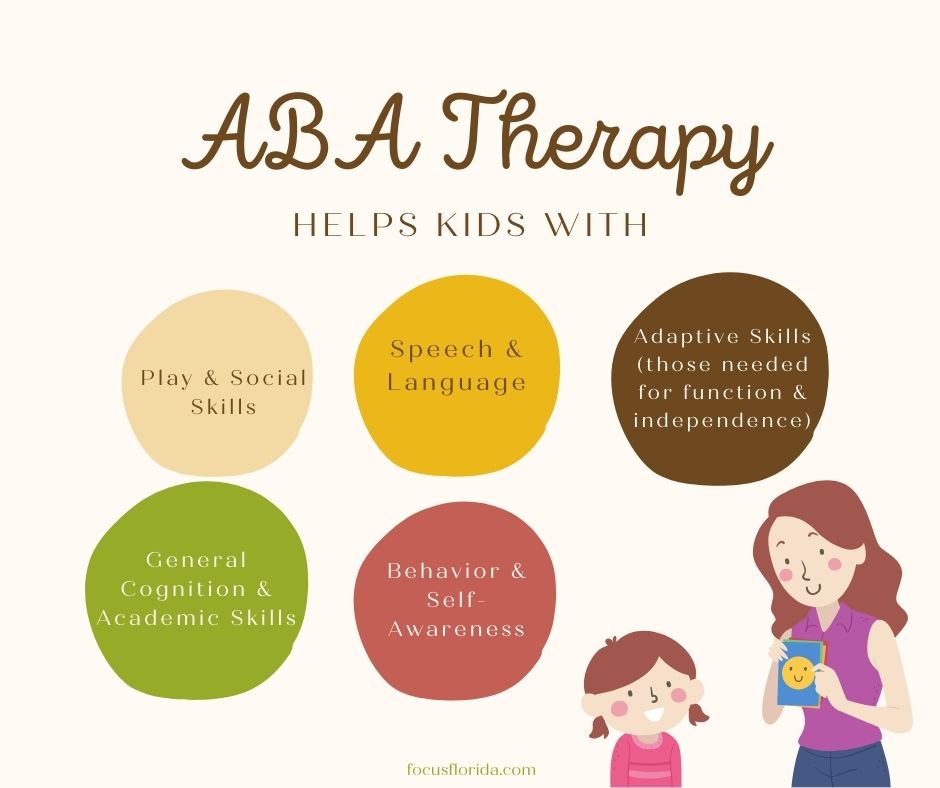
How ABA Therapy Can Help Fort Myers Kids
ABA therapy (short for applied behavioral analysis) is an evidence-based therapy that focuses on studying the “ABCs” of behavior to learn the function of it. From there, we can use positive reinforcement to create an environment that helps promote expected behaviors and minimize unexpected behaviors, We start with A, the antecedent, (what comes before the behavior), then B, the behavior itself, and then C, the consequence (what comes right after the behavior).
All behavior has a function. At its core, behavior is a means of communication. We work to understand what the child is gleaning from the behavior (avoidance? sensory input? a reaction?). We also find out what really interests or motivates them. We then use scientifically-proven strategies that will help us tailor a unique treatment plan to promote helpful behaviors and fade/extinct unhelpful behaviors.
When ABA therapy is successful, it can help with skills key to independent function. Learn more about FOCUS Fort Myers ABA Therapy services here.
FOCUS offers pediatric behavior therapy, occupational therapy, speech therapy, and physical therapy in Southwest Florida. Call (239) 313.5049 or Contact Us online.
Additional Resources:
What is Applied Behavior Analysis? Autism Speaks
More Blog Entries:
FOCUS Therapy ABA Talks: Hosted by Our ABA Team! July 31, 2021, Fort Myers Behavior Therapy Blog

FOCUS Therapy Holiday Theme Days – Wear Your PJs & Christmas Gear!
It’s feeling festive here at FOCUS Therapy! Come to the clinic Tuesday, 12/21/21, rocking your favorite jammies. On Wednesday, 12/22/21, come wearing your Santa hats, your red & green & your jingle bells!

Does My Child Need Pediatric Speech Therapy?
If you’re wondering whether your child might need pediatric speech therapy (speech therapy provided to kids), it’s best not to “wait-and-see.” That’s because problems compound, bad habits become more ingrained, and neural pathways critical to learning become more inflexible.
Another thing to bear in mind is the proven success of early intervention. As noted by the American Speech-Language-Hearing Association (ASHA), early intervention is the process of providing support to infants, toddlers, and young children who have or are at risk for a developmental delay, disability, or health condition that might impact typical development and learning. The earlier services are delivered, the more likely the child is going to develop effective communication, language, and swallowing skills.
Areas of Development Pediatric Speech Therapy Targets
Pediatric speech therapy will target five areas of development, including:
- Communication development.
- Cognitive development.
- Physical development, including vision and hearing.
- Social-emotional development.
- Adaptive development.
FOCUS Therapy is highly effective in treating a wide range of delays, disabilities, injuries and challenges – in large part because we’re working on site at our two Fort Myers clinics with inter-disciplinary teams that include not only speech therapists, but occupational therapists, ABA therapists (who target behavior), and physical therapists.
For more information on whether your child may not be reaching important speech-language development milestones, ASHA is a great resource! So is your pediatrician, who can issue a referral for your child to be assessed by a trained speech-language pathologist with a full evaluation, which can shed light on challenges as well as treatment solutions.
FOCUS offers pediatric speech therapy at two clinics in Fort Myers, with virtual speech therapy and occupational therapy offered to kids throughout the state of Florida. Call (239) 313.5049 or Contact Us online.
Additional Resources:
Speech-Language Development 2-3 Years, ASHA
More Blog Entries:
Fort Myers Speech Therapist Tips on Reducing Kids’ Screen Time, Nov. 5, 2021, Ft. Myers Speech Therapy Blog
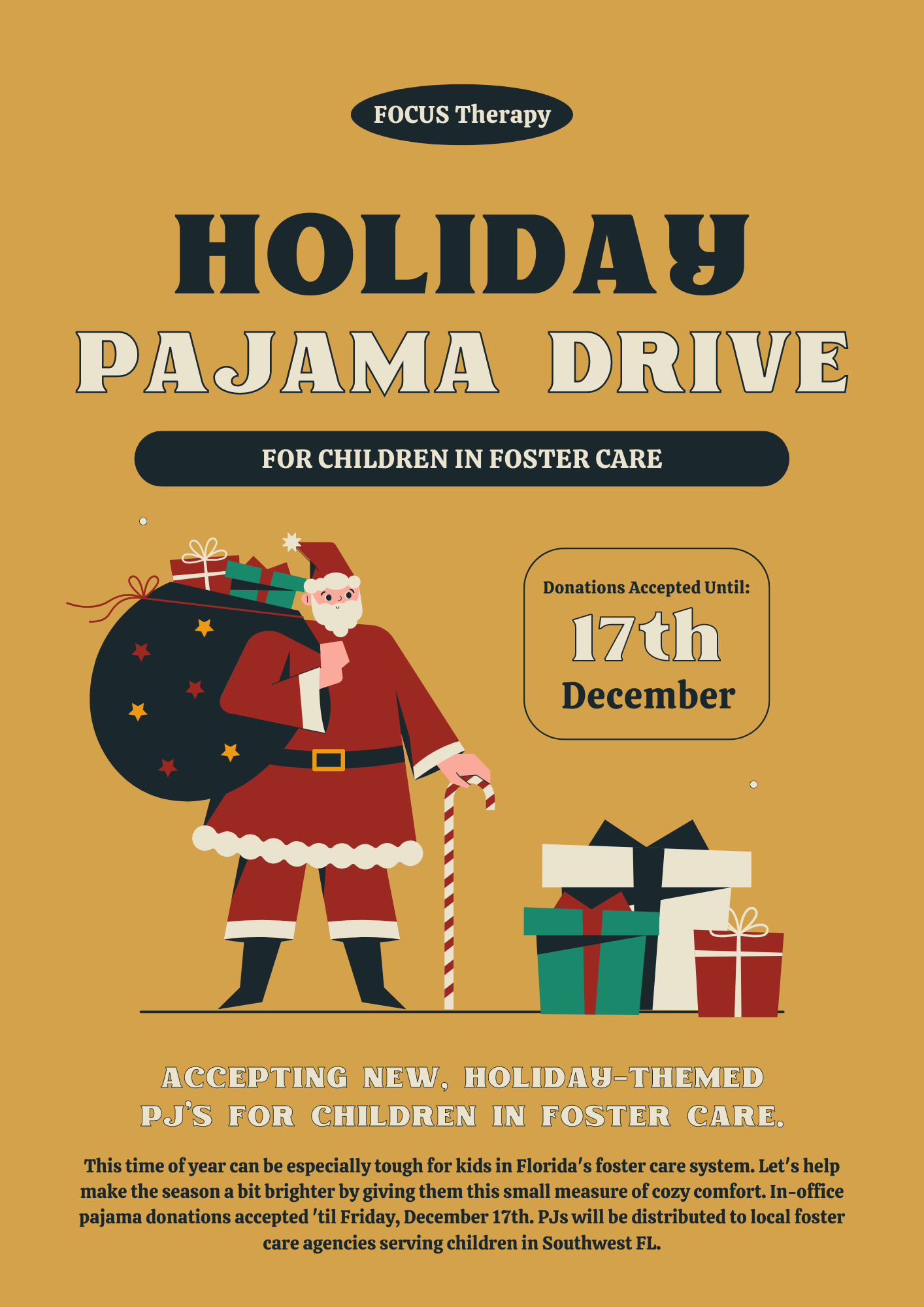
FOCUS Therapy Hosting Holiday PJ Drive for SWFL Kids in Foster Care
The holidays can be an especially lonely time for the estimated 19,000 kids in Florida’s foster care system. Many of these children are without not only their parents, but also siblings, extended family, and most material possessions. FOCUS Therapy is hoping we can come together to help offer them a small measure of comfort this season: Cozy, holiday-themed pajamas.
Lots of other wonderful organizations locally do holiday gift drives, so we thought we’d do something a little different: Give these kids something comfy to snuggle up in.
We’re asking for donations of brand new, soft, holiday-themed pajama sets. Donations are welcomed for boys and girls of all ages & sizes. Statistically, the average age of a child in foster care is 8, and there are slightly more boys than girls.
We’ll be collecting these PJs at our two FOCUS Therapy locations, at Royal Gulf Circle and Interstate Commerce Drive.
Foster care is the temporary placement of children and youth with families outside their own home due to abuse, neglect, or other circumstances. The goal is to provide a stable, nurturing environment in a time of crisis until they can be reunited with their parents or extended family members. Many children in foster care arrive to their temporary placements with little more than the clothes they’re wearing.
To learn more about the Florida foster care system or becoming a foster parent, visit the Florida Department of Children & Families at https://www.myflfamilies.com/service-programs/foster-care/.
If you have questions about donations or FOCUS Therapy in general, call our office at (239) 313-5049.