
Blog

W-Sitting, Toe-Walking, and Clumsiness: Fort Myers Occupational Therapists Red Flags
Your four-year-old is playing on the living room floor and you notice they’re sitting in that strange position again, legs splayed out behind them like a letter W, while their sibling sits cross-legged. Or maybe your son has been walking on his tiptoes since he started walking, and everyone keeps telling you he’ll grow out of it. Or perhaps your daughter trips over her own feet so often that she’s become the kid who always has a scraped knee. As Fort Myers occupational therapists, we want parents to know they’re right to pay attention, trust their gut, and ask for an outside opinion when something seems off. Many of these “physical quirks are among the earliest, “quirks” are among the earliest and most visible signs that a child’s sensory or motor development could use some support. The good news is that with early intervention through pediatric occupational therapy, some of these concerns can be addressed entirely before school readiness is affected.
What is W-sitting and why do kids do it?
W-sitting happens when a child sits on the floor with their bottom on the ground, knees bent forward, and both feet pointing outward on either side of their hips. If you looked down from above, their legs form the shape of a capital W. It’s surprisingly common in toddlers and preschoolers, and sometimes it’s a child’s default to this position because it actually feels stable and comfortable.
The problem has less to do with the sitting itself and more with the fact that it can be a warning sign. Children gravitate toward W-sitting because it creates a wide base without requiring their core muscles to work. It’s essentially a cheat code around core stability. When children don’t develop core strength and trunk control properly, their bodies find a mechanical workaround — and W-sitting is one of the most common ones.

Why it matters beyond just posture
Short-term W-sitting isn’t dangerous. But children who habitually sit this way may develop real concerns over time — tightening of hip muscles and tendons (particularly the hip flexors and internal rotators), reduced balance and core strength, and difficulty with the rotation movements that are essential for tasks like crossing the midline of the body.
Crossing the midline — reaching your right hand to the left side of your body, or vice versa — is something we take for granted as adults, but it’s a crucial developmental milestone. It underpins handwriting, sports coordination, and even the ability to read a page left to right. Children who W-sit excessively may avoid or struggle with these crossing movements without anyone connecting the dots.
When to pay attention
Occasional W-sitting in toddlers is normal. It becomes a concern when a child only sits this way, resists being repositioned, or is over age 4–5 and still defaulting to this position exclusively. If you notice it paired with clumsiness, delayed milestones, or low muscle tone, that’s a stronger signal.
What to try at home
You can gently encourage better sitting habits by reminding your child to sit “criss-cross applesauce” or in a side-sit position, and by building core strength through play (think obstacle courses, crawling games, and activities that challenge balance). But if W-sitting is the overwhelming preference and your child resists alternatives, an occupational therapy evaluation can identify whether an underlying sensory or motor issue is driving the behavior.
Toe-walking: habit, phase, or hidden signal?
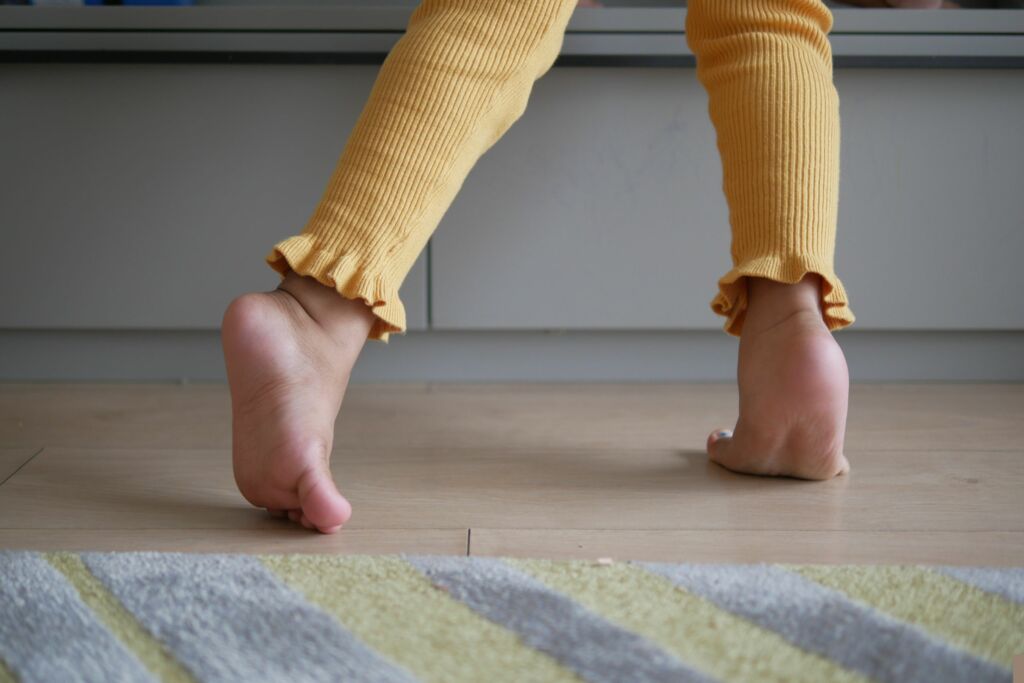
Nearly every toddler goes through a toe-walking phase. When children are first learning to walk, walking on their tiptoes is normal and expected — it’s part of experimenting with movement. Most children transition to heel-toe walking naturally by the time they’re 2 or 3 years old.
When toe-walking persists past age 3, and especially past age 4, parents are right to take a closer look. Persistent toe-walking — sometimes called “habitual toe-walking” or “idiopathic toe-walking” — is one of the most Googled childhood physical concerns for a reason: it’s common, it’s visible, and it has a wide range of possible causes.
Why kids toe-walk: the full picture
There’s no single reason children continue to toe-walk. Some causes are structural (a shortened Achilles tendon or tight calf muscles can physically make flat-footed walking uncomfortable). Other causes are neurological, since conditions like cerebral palsy and hereditary spastic paraplegia can affect gait. And increasingly, occupational therapists are identifying sensory processing differences as a major driver.
Children with sensory processing disorder, sensory seeking behaviors, or sensory defensiveness may toe-walk because of how the ground feels to them. Some children are hypersensitive to the sensation of their full foot touching a surface, the pressure, texture, or temperature can be genuinely overwhelming. Others are hypo-sensitive and toe-walk because the increased proprioceptive input from calf muscle tension feels regulating. Either way, the behavior is sensory-driven, not deliberate or defiant.
The sensory connection most parents miss
A child who toe-walks and dislikes walking barefoot on grass, sand, or certain textures, or who is particularly bothered by socks, shoes, or tags, may be showing you a sensory processing pattern. These details together are very useful for a pediatric OT evaluation.
What persistent toe-walking can affect
Left unaddressed, habitual toe-walking can lead to tightened calf muscles and a shortened Achilles tendon, making flat-footed walking progressively harder, not easier, over time. It can also affect balance, coordination, and even participation in physical activities and sports. Some children begin to avoid activities where they feel unsteady, which compounds the issue.
Age-by-age expectations
12–24 months Normal to experiment with toe-walking
2–3 years Should mostly transition to heel-toe; occasional toe-walking still common
3–4 years Persistent toe-walking warrants monitoring and possible evaluation
4+ years Consistent toe-walking should be evaluated by a professional
Clumsiness: when “she’s just not sporty” isn’t the whole story
Every child trips and bumps into things sometimes. Physical clumsiness is a normal part of childhood. But there’s a difference between the typical childhood tumble and the child who consistently struggles with motor coordination in ways that affect daily life — the child who can’t seem to catch a ball, who spills drinks repeatedly, who has enormous difficulty with buttons, zippers, or utensils, or who seems unaware of where their body is in space.
This pattern has a clinical name: Developmental Coordination Disorder, or DCD. It’s estimated to affect approximately 5–6% of school-age children, making it more common than most parents realize. DCD doesn’t reflect intelligence or effort — many children with DCD are bright, motivated kids who simply struggle to translate their intentions into smooth, coordinated movement.
What “clumsy” can really look like:
Fine motor
Difficulty with buttons, zippers, using scissors, holding pencils; handwriting that looks labored or illegible for their age
Gross motor
Difficulty catching balls, riding a bike, climbing playground equipment; frequent falls and bumps into furniture or people
Body awareness
Poor proprioceptive sense — doesn’t seem to “know” where their body is in space; stands too close to others, bumps into walls, misjudges distances
Daily tasks
Struggles more than peers with dressing, self-care, eating with utensils; avoids activities that require physical coordination
The emotional cost parents often underestimate
One of the most important things to understand about motor coordination difficulties is the emotional impact. Children who struggle with coordination know they’re struggling. By preschool and certainly by elementary school, they’re comparing themselves to peers and often coming up short in ways they can feel but not articulate. This can lead to avoidance of physical play, lower self-confidence, and in some cases, anxiety or social withdrawal.
“The goal of pediatric occupational therapy isn’t to ‘fix’ a child. It’s to help them do the things they want and need to do — with more confidence, more ease, and more joy.”
Identifying and addressing coordination difficulties early, before a child has developed a narrative that they’re “just not good at things,” can protect both their motor development and their sense of self.
Other physical red flags to watch for at home
W-sitting, toe-walking, and clumsiness are three of the most visible signs, but they’re not the only ones. Parents who are seeing one of these behaviors should also look for:
- Hypersensitivity or strong aversion to textures, sounds, lights, or touch — including clothing tags, food textures, or being touched unexpectedly
- The opposite — a child who seems to crave intense sensory input and frequently crashes into things, jumps from heights, or seeks deep pressure
- Difficulty with transitions between activities or significant emotional dysregulation
- Low muscle tone — a child who tires quickly, slouches heavily, has difficulty sitting upright at a table, or prefers to lie down during activities
- Delays in self-care milestones — dressing, feeding, grooming tasks taking much longer than expected for their age
- Handwriting difficulties in school-age children that don’t improve with practice
- Difficulty with bilateral coordination — tasks that require both hands working together, like cutting with scissors or tying shoelaces
None of these signs in isolation necessarily indicates a problem — context and pattern matter. But the more of these you recognize in your child, the more valuable a professional evaluation becomes.
Common things parents tell themselves — and What Fort Myers Occupational Therapists’ Responses
| What Parents Often Think | What Professionals Actually See |
| She’ll Grow Out of It | Some children do — but many don’t, and waiting can allow compensatory habits to deepen, making intervention more intensive later. |
| “All kids are clumsy — I was too.” | Familial motor patterns are real, but if it’s consistently affecting your child’s daily life or confidence, it’s worth evaluating regardless of family history. |
| “My pediatrician didn’t mention it.” | Pediatricians see children briefly and focus on health and development broadly. Subtle motor and sensory concerns are often best caught by specialists who observe movement in depth. |
| “OT is for kids with serious disabilities.” | Pediatric OT serves a wide range of children — from those with significant needs to children who are largely typical but have specific areas that need support. Many OT clients are kids who simply need some extra help in targeted areas. |
| “I’d need a referral — that’s a whole process.” | Many pediatric OT practices, including those in Fort Myers, accept self-referrals and can evaluate your child without needing a physician’s order first. |
How pediatric occupational therapy in Fort Myers actually works
If you’ve never worked with an occupational therapist, the process can feel mysterious. Here’s a clear picture of what to expect.
The evaluation
An evaluation by one of our Fort Myers occupational therapists is typically a one- to two-hour session where a trained therapist observes your child’s movement, balance, coordination, sensory responses, and functional skills. It doesn’t feel like a test to the child — most evaluations are play-based and happen in a space designed to feel engaging and non-threatening. Parents are usually present and often asked to share observations from home, which is extremely valuable input.
The therapist will assess things like muscle tone, range of motion, motor planning, bilateral coordination, sensory processing, and fine and gross motor skills. From this, they develop a picture of your child’s strengths and the areas that could benefit from intervention.
What therapy looks like
Pediatric OT sessions are designed around play — because play is how children learn and develop. A child working on core strength might do obstacle courses, balance beam activities, or games that require holding positions. A child with toe-walking might work on sensory integration activities that help their nervous system become more comfortable with foot contact and pressure. A child with fine motor delays might work with tools, manipulatives, and crafts that build hand strength and coordination.
The “magic” of good pediatric OT is that children often don’t realize they’re working. They’re playing and making real developmental gains in the process.
Parent involvement is part of the process
Effective pediatric OT doesn’t happen only in the clinic. Therapists work with parents to develop home strategies and activities that reinforce progress between sessions. This means you’re not dependent on weekly appointments, you become a partner in your child’s progress, equipped with specific, practical tools you can use every day.
Fort Myers families
Focus Florida serves families throughout the Fort Myers area with pediatric occupational therapy evaluations and treatment. Our therapists specialize in sensory processing, motor development, and helping children build the skills they need to thrive at home, at school, and in play.
When and how to get your child evaluated
If you’ve been reading this and quietly checking boxes: trust that instinct. Our Fort Myers occupational therapists at FOCUS Therapy recognize that parental observation is genuinely valuable clinical information, and your concern is worth taking seriously.
You don’t need to wait for a pediatrician referral, for a teacher to flag something, or for your child to fall significantly behind. In fact, the earlier a child receives support, the better the outcomes tend to be — not because late intervention doesn’t work, but because early development is a window of high neuroplasticity where gains come more naturally.
Your next steps
- Note what you’re seeing.Write down the specific behaviors — how often, in what contexts, since when. This detail is helpful in an evaluation.
- Talk to your child’s teacherif they’re school-age. Teachers observe motor and sensory behaviors across the day and can add important context.
- Contact a pediatric OT practice directly.You can often call or submit a form without a physician referral to schedule a screening or evaluation.
- Ask about insurance coverage. Many insurance plans cover pediatric OT evaluations and therapy when there is a documented functional need. Staff can help you navigate this.
Concerned about your child’s development?
Focus Florida’s pediatric occupational therapy team in Fort Myers is here to help you find answers and a path forward. Call us today to schedule a consultation.
FOCUS offers pediatric occupational therapy in Fort Myers, Florida. Call (239) 313.5049 or Contact Us online.
Additional Resources:
Nordon, D. G., et al. (2024). “W-Sitting In Childhood: A Systematic Review.” Acta Ortopédica Brasileira. Read the full study here.
More Blog Entries:
This article is intended for informational purposes and does not constitute medical advice. If you have concerns about your child’s development, please consult with a qualified healthcare provider or contact a licensed occupational therapist for an individualized assessment.
Comments are closed.