
Blog
Building Routines: Fort Myers Parent Coaching Teaches Consistency for Kids Who Need Predictability
For many children, particularly those with developmental differences, autism spectrum disorder, ADHD, or sensory processing challenges, predictability isn’t just preferable—it’s essential. At FOCUS Therapy, our Board Certified Behavior Analysts (BCBAs) work closely with parents receiving our Fort Myers parent coaching services to develop consistent routines that create a sense of security and foster developmental growth.
Why Predictable Routines Matter
Children thrive on knowing what to expect. Research consistently shows that predictable environments help children develop:
- Improved emotional regulation
- Reduced anxiety and behavioral challenges
- Greater independence in daily activities
- Enhanced ability to transition between activities
- Stronger parent-child relationships
Dr. Ronit Molko, a renowned expert in behavioral intervention, notes that “predictability creates a foundation of safety from which children can explore, learn, and develop critical skills.” When children understand what comes next in their day, they’re better equipped to manage their emotions and engage meaningfully with their environment.
The Science Behind Routine and Predictability
Research supports the effectiveness of consistent routines for children’s development. Studies have shown that household routines are associated with better self-regulation skills in young children, particularly those with developmental challenges.
One compelling study published in the Journal of Developmental & Behavioral Pediatrics demonstrated that consistent bedtime routines were linked to improved sleep quality, daytime behavior, and parent-child interactions.
Signs Your Child May Benefit from More Structure
Our Fort Myers parent coaching / child behavior specialists often hear from parents who aren’t sure if their child needs more routine. Consider these indicators:
- Frequent meltdowns during transitions
- Difficulty adapting to changes in schedule
- Asking repetitive questions about what will happen next
- Resistance to participating in family activities
- Sleep difficulties
- Increased anxiety in new situations
If these signs sound familiar, implementing more structured routines could significantly benefit your child and your entire family. Behavior consulting can help.
Creating Effective Routines: The FOCUS Approach
At FOCUS Therapy, our Fort Myers parent coaching is about empowering parents with practical strategies to build routines that work. Here’s our evidence-based framework:
1. Start with Visual Supports
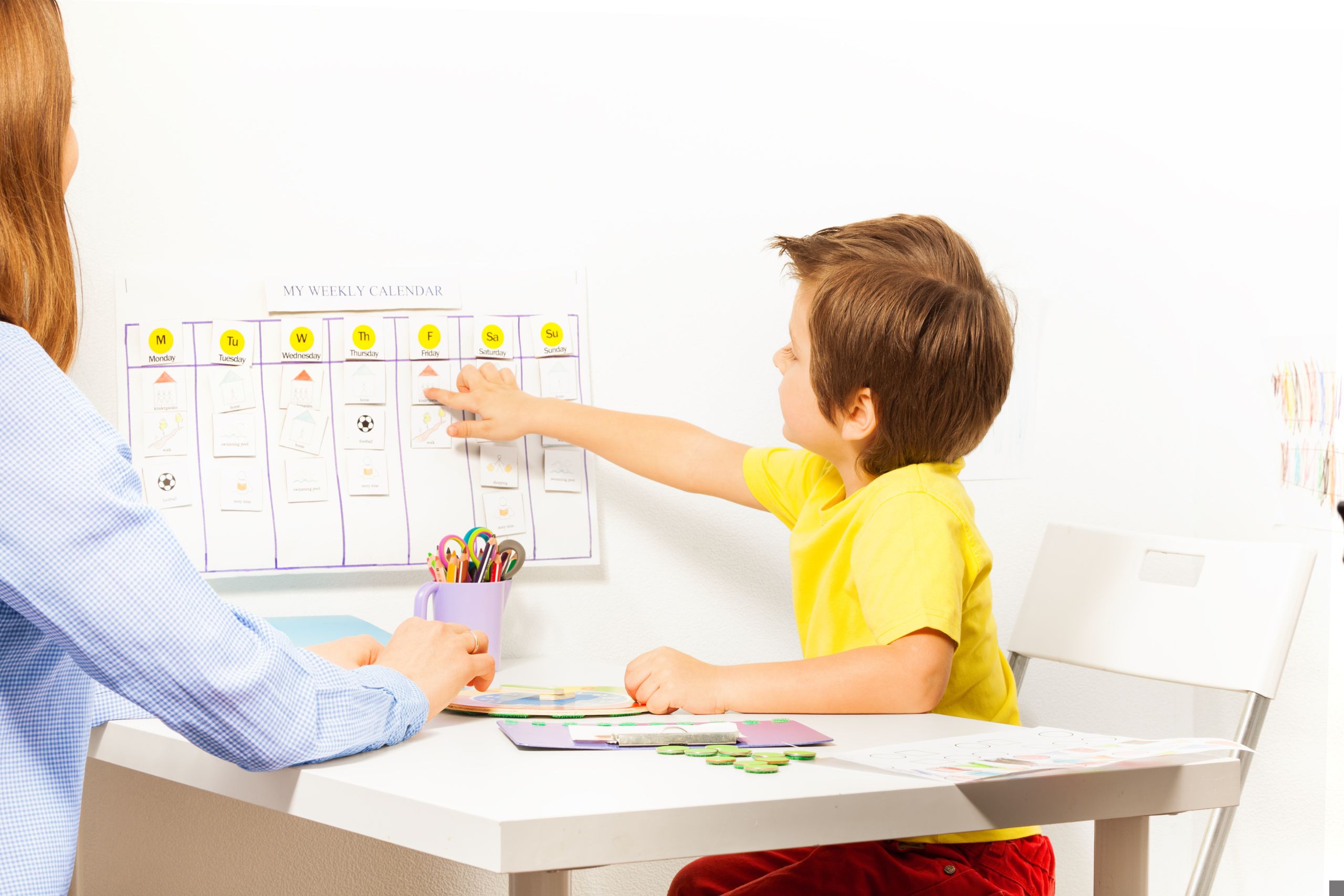
Children who struggle with processing verbal information benefit tremendously from visual schedules. Research from the American Journal of Occupational Therapy shows that visual supports increase independence and reduce challenging behaviors.
Practical Tip: Create a simple visual schedule using pictures or icons that represent daily activities. Review it together each morning and reference it throughout the day.
2. Build Consistency Across Environments
Effective routines maintain consistency across different settings—home, school, therapy sessions, and other environments your child frequents. Our Fort Myers parent coaching specialists work with families to coordinate routines across settings.
Practical Tip: Share your visual schedules and routine strategies with teachers, grandparents, and other caregivers to maintain consistency.
3. Incorporate Sensory Considerations
Many children who need predictability also have sensory processing differences. A 2021 study in the Journal of Autism and Developmental Disorders found that incorporating sensory strategies into daily routines significantly reduced anxiety and improved compliance.
Practical Tip: Build in regular sensory breaks throughout the day, such as jumping, deep pressure activities, or quiet time with headphones.
4. Create Transition Warnings
Transitions often trigger distress in children who need predictability. Our BCBAs teach parents to implement effective transition strategies.
Practical Tip: Use timers, countdowns, or transition songs to signal upcoming changes. For example, “In five minutes, we’ll clean up and go to lunch.”
5. Establish Priority Routines
Research suggests focusing on these key daily routines first:
- Morning routine
- Mealtime routine
- Bedtime routine
- Homework/after-school routine
A structured study in Pediatrics found that consistent mealtime and bedtime routines were associated with better health outcomes, including reduced obesity risk and improved sleep.
6. Build in Flexibility Gradually
While predictability is important, some flexibility is necessary for real-world functioning. Our parent coaching program teaches families how to gradually introduce controlled changes to routines.
Practical Tip: Start with small variations in less problematic routines, preparing your child in advance and praising successful adaptation.

When Routines Aren’t Working: Troubleshooting with Expert Fort Myers Parent Coaching Support
Sometimes, despite best efforts, routines don’t seem to “stick.” Our Fort Myers parent coaching specialists identify common challenges:
- The routine may be too complex
- It may not accommodate your child’s sensory needs
- There might be underlying issues requiring additional support
- Environmental factors may be interfering
Through our comprehensive parent coaching program, FOCUS Therapy’s BCBAs provide ongoing support to refine routines and address challenges as they arise.
Fort Myers Parent Coaching at FOCUS Therapy
At FOCUS Therapy, our Fort Myers parent coaching services offers something unique: child behavior specialists who understand the intersection of behavioral analysis, child development, and family dynamics.
A 2020 study in the Journal of Applied Behavior Analysis demonstrated that parent-implemented interventions guided by BCBAs produced significant improvements in child behavior and reduced parental stress.
Our parent coaching program provides:
- Personalized routine development based on your child’s specific needs.
- Evidence-based strategies drawn from applied behavior analysis.
- Coordination with other therapies your child may receive (speech therapy, occupational therapy, ABA).
- Ongoing support as your child grows and needs evolve.
Taking the First Step
Building effective routines doesn’t happen overnight. It requires consistency, patience, and expert guidance. If you’re struggling with establishing routines that work for your child, FOCUS Therapy’s Fort Myers parent coaching / behavior consulting services can help.
Our BCBAs work alongside parents, providing the tools and strategies needed to create the predictable environment in which children with developmental differences thrive. Remember that even small improvements in routine can lead to significant positive changes in your child’s behavior and overall well-being.
To learn more about our evidence-based parent coaching services in Fort Myers, contact FOCUS Therapy today. Together, we can build routines that support your child’s unique developmental journey and strengthen your entire family.
FOCUS Therapy offers comprehensive pediatric services including ABA therapy, speech therapy, occupational therapy, and parent coaching in Fort Myers. Our team of dedicated professionals works together to support children with developmental differences and their families.
Additional Resources:
How the Activity Schedules Impact the Children with Autism Spectrum Disorder? A Meta-analysis, January 2023, Egitimbilim, Journal of Theoretical Educational Science
More Blog Entries:

Feeding Therapy Strategies for Family Mealtimes With Your Picky Eater
Mealtime should be a nourishing experience—both nutritionally and emotionally—for families. However, for parents of picky eaters, the dinner table can become a battleground of frustration, worry, and stress. At FOCUS Therapy, we understand the unique challenges faced by families navigating feeding difficulties, whether stemming from sensory processing differences, oral motor challenges, or developmental concerns. Feeding therapy can help.
Our multidisciplinary team of occupational therapists, speech-language pathologists, and behavior analysts work together to support children and families through comprehensive, evidence-based approaches to our Fort Myers feeding therapy.
Understanding Feeding Sensitivities
Feeding sensitivities with kids can manifest in various ways:
- Sensory Processing Differences. Heightened sensitivity to textures, temperatures, tastes, or smells. that can make certain foods feel overwhelming or intolerable.
- Oral Motor Challenges. Difficulties with chewing, swallowing, or manipulating food in the mouth.
- Behavioral Components. Anxiety, rigidity, or negative associations with eating situations.
- Medical Factors. Reflux, allergies, or other conditions that can make eating uncomfortable or painful.
Research indicates that approximately 25% of typically developing children and up to 80% of children with developmental differences experience feeding challenges. Understanding the specific nature of your child’s feeding sensitivity is the first step toward effective intervention.
Creating a Supportive Mealtime Environment
1. Establish Consistent Routines
Children who are “picky eaters” often have feeding sensitivities — and they tend to do best with mealtimes when there is some measure of predictability. Consistent mealtime routines are known to reduce anxiety and increase food acceptance in children with feeding difficulties.
Practical strategies:
- Serve meals at approximately the same times each day.
- Follow a predictable pre-meal routine (handwashing, setting the table, etc.).
- Use a visual schedule to illustrate mealtime steps.
- Maintain the same seating arrangements when possible.
2. Design a Sensory-Friendly Space
Environmental factors can significantly impact a “picky eater’s” willingness and ability to engage with food.
Practical strategies:
- Minimize distractions (turn off TV, reduce background noise).
- Consider lighting—some children are sensitive to bright or fluorescent lights.
- Provide seating that supports proper positioning (feet flat, hips and knees at 90-degree angles).
- Offer adaptive utensils or plates if needed (speak with your occupational therapist about recommendations).
- Have a “safe space” nearby if your child needs a sensory break.
3. Model Positive Eating Behaviors
Children learn by watching others. Parental modeling at mealtimes can be a powerful influence on children’s eating behaviors.
Practical strategies:
- Eat together as a family whenever possible.
- Demonstrate enjoyment and positive language around food.
- Avoid making negative comments about foods you dislike.
- Show interest in trying new foods yourself.
- Talk about the sensory properties of foods in neutral terms (“This apple is crunchy” rather than “Do you like it?”).
Evidence-Based Strategies for Mealtime Success
1. The Division of Responsibility Approach
Developed by registered dietitian Ellyn Satter, this approach defines clear roles for parents and children:
- Parents decide: What food is offered, when meals happen, where meals occur.
- Children decide: Whether to eat and how much to eat.
This approach reduces mealtime pressure and has been shown to improve long-term feeding outcomes.
Practical strategies:
- Provide at least one food your child typically accepts at each meal.
- Avoid forcing, bribing, or rewarding eating behaviors.
- Trust your child’s internal hunger and fullness cues.
- Focus on making mealtimes pleasant rather than on the quantity consumed.
2. Systematic Desensitization
For children with strong sensory aversions, gradual exposure to new foods is key. Research indicates that a step-by-step approach helps reduce anxiety and build tolerance.
Practical strategies:
- Use a food hierarchy moving from simply tolerating food nearby to interacting with and eventually tasting it.
- Encourage interaction with food through play (outside of mealtimes).
- Practice the “one-bite rule” with flexibility—ask for a tiny taste but don’t force it.
- Celebrate small victories, like touching or smelling a new food.
3. Visual and Tactile Food Exploration
Many children benefit from non-pressured opportunities to explore foods using multiple senses before eating them. Research has shown that multisensory exposure significantly increased food acceptance in children with feeding difficulties.
Practical strategies:
- Allow food exploration with hands (even if messy).
- Describe foods using specific sensory terms (crunchy, smooth, cold).
- Create food art or play games with foods to increase familiarity.
- Use food chaining—connecting preferred foods to new foods with similar properties.
4. Addressing Oral Motor Challenges
For children with difficulties chewing, swallowing, or managing different textures, specific strategies targeting oral motor skills can be beneficial.
Practical strategies:
- Ensure proper positioning during meals (stable core, feet supported).
- Offer foods that match your child’s oral motor abilities (as guided by your speech-language pathologist).
- Practice oral motor exercises recommended by your therapy team.
- Consider using specialized feeding utensils or cups.
Special Considerations for Children with Autism Spectrum Disorder (ASD)
Children with ASD often face unique challenges around feeding. A comprehensive review by Ledford & Gast found that structured behavioral approaches combined with sensory integration techniques showed the greatest success for these children.
Practical strategies:
- Implement visual supports to increase predictability.
- Consider the sensory environment carefully (lighting, sounds, smells).
- Use high-interest activities or special interests to encourage food interaction.
- Work with a Board Certified Behavior Analyst (BCBA) to develop individualized reinforcement strategies.
- Progress at your child’s pace, recognizing that change may be especially challenging.
When Professional Feeding Therapy Support Is Needed
While many feeding issues can improve with home strategies, some situations warrant professional intervention. Some that might:
- Limited food variety (fewer than 20 different foods).
- Nutritional concerns or weight loss/insufficient gain.
- Mealtime behaviors that are disruptive to family functioning.
- Signs of swallowing difficulty (coughing, choking, gagging).
- Anxiety or distress that impacts quality of life.
At FOCUS Therapy, our interdisciplinary approach allows us to address feeding challenges comprehensively through:
- Occupational Therapy. Addressing sensory processing and motor planning aspects of feeding.
- Speech-Language Pathology. Focusing on oral motor skills, swallowing safety, and communication during meals.
- Specialized Feeding Therapy. Combining techniques from both disciplines for targeted intervention.
- Applied Behavior Analysis (ABA). Implementing structured behavioral approaches to expand food acceptance.
- Family Support. Providing education, emotional support, and practical strategies for implementation at home.
The journey toward positive mealtimes for children with feeding sensitivities isn’t always linear. But with patience, consistency, and evidence-based strategies used in Fort Myers feeding therapy, progress is possible. Remember that small steps are worth celebrating, and that building a healthy relationship with food takes time.
At FOCUS Therapy, we’re committed to partnering with families to create individualized plans that address each child’s unique needs. If you’re concerned about your child’s feeding patterns or mealtime behaviors, our team is here to help.
Schedule a Consultation
If you’re concerned about your child’s eating habits, our multidisciplinary team may be able to help. FOCUS Therapy offers pediatric feeding therapy and swallowing therapy in Fort Myers. Call (239) 313-5049 or Contact Us online.
Additional Resources:
What is Feeding Therapy? Can it Help Your Child Eat Better? Sept. 23, 2024, WebMD
More Blog Entries:
Sensory Processing 101
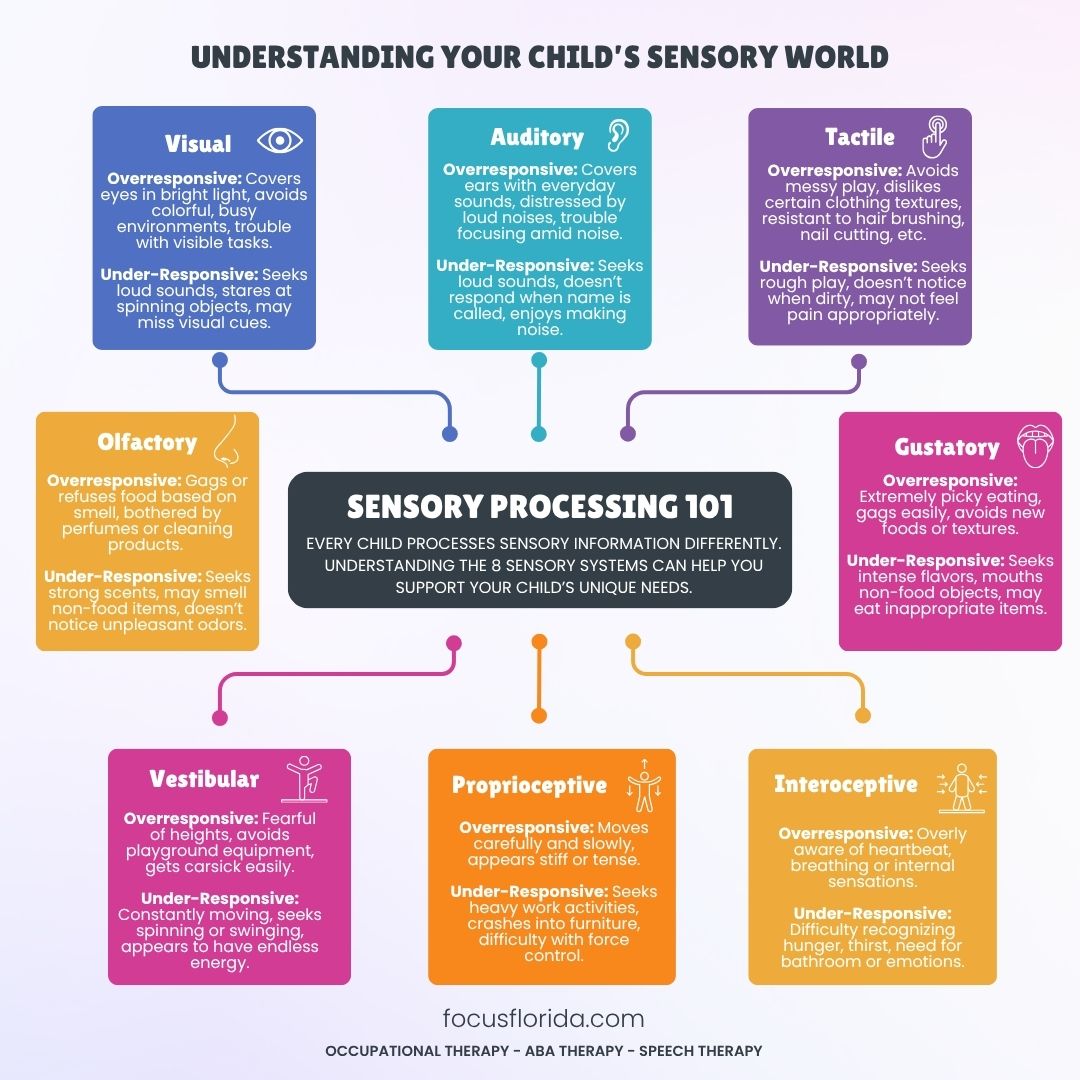
Check out these insights on your child’s sensory processing systems from our pediatric occupational therapists in Fort Myers.
Consider seeking an occupational therapy evaluation if your child:
- Has difficulty participating in daily activities due to sensory challenges
- Shows extreme reactions to sensory input
- Avoids or seeks sensory experiences in ways that impact learning or social participation
- Struggles with self-regulation related to sensory processing
FOCUS Therapy offers occupational therapy, ABA therapy, occupational therapy, speech therapy, parent coaching, IEP assistance and ADOS testing in Fort Myers, Florida. Call (239) 313.5049 or Contact Us online.
How to Use a First Then Board
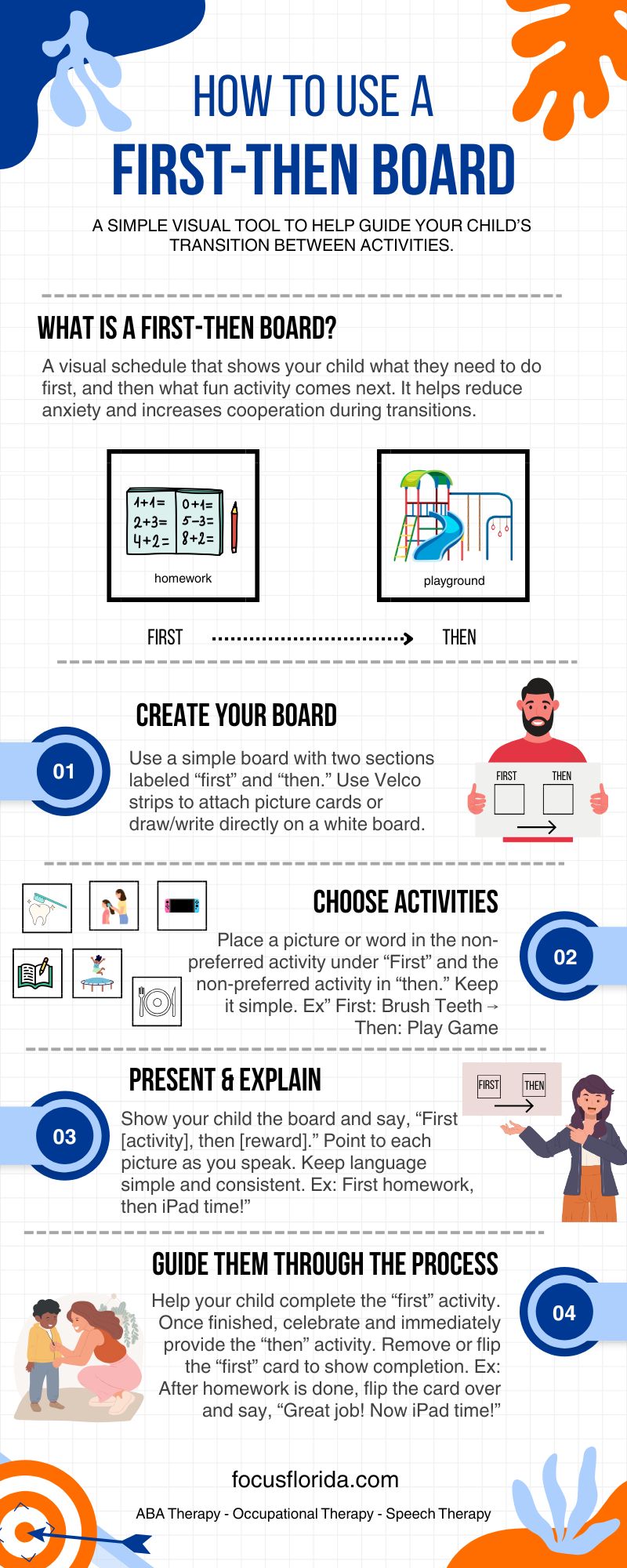
Our ABA and occupational therapists can help parents create and effectively use a first then board – which can go a long way toward helping with transitions.
It’s important to be consistent. Use the same language and format every time. Always follow through with the “then” activity to build trust and understanding.
Some additional tips for success:
- Start with highly-preferred “then” activities to build motivation.
- Keep “first” tasks short and achievable initially.
- Use pictures for non-readers, and words or both for readers.
- let your child help remove/flip the cards when tasks are done.
- Be patient – it may take time for your child to understand the system and what’s expected of them.
Need more support? Our pediatric occupational therapists, ABA therapists and parent coaching services can help you implement visual supports like first then boards effectively at home.
FOCUS Therapy offers occupational therapy, ABA therapy, occupational therapy, speech therapy, parent coaching, IEP assistance and ADOS testing in Fort Myers, Florida. Call (239) 313.5049 or Contact Us online.

Co-Treatment Sessions: When Two Therapists Are Better Than One
At FOCUS Therapy, a multidisciplinary pediatric therapy clinic in Fort Myers, Florida, we believe in the power of collaboration. That belief is at the heart of co-treatment sessions — a dynamic and highly effective approach where two therapists from different disciplines (such as speech therapy, occupational therapy, and ABA therapy) work with a child at the same time.
When a child is developing skills across multiple areas—like communication, motor planning, sensory regulation, and behavior—co-treatment can be a game-changer. It’s not just about efficiency; it’s about synergy. When therapists come together, their combined expertise can create a powerful, unified path toward your child’s goals.
What Is a Co-Treatment Session?
A co-treatment session involves two therapists working with your child simultaneously — typically for a 50-60-minute session. These sessions are thoughtfully planned in advance and guided by shared goals, individualized treatment plans, and consistent communication between therapists.
Rather than each therapist working in isolation, they join forces in real time to:
- Integrate skills across disciplines.
- Reinforce consistent strategies and expectations.
- Reduce sensory or behavioral barriers to learning.
- Create a more engaging, functional, and motivating environment.
When Is Co-Treatment Recommended?
Co-treatment is not the default, but it’s an incredibly effective tool when used strategically. Our therapists may recommend co-treatment when:
- A child has overlapping goals across two therapy domains (e.g., motor planning and speech production).
- One area of development (like sensory regulation) is blocking progress in another (like expressive language).
- A child needs real-time support from one therapist to participate effectively in another’s treatment.
- We’re working on daily living or functional tasks (e.g., feeding, dressing, toileting) that benefit from a combined therapeutic approach.
- A child shows better engagement or reduced anxiety when two trusted therapists collaborate in a single, predictable setting.

Common Co-Treatment Combinations and How They Help
1. Speech Therapist + Occupational Therapist
This is one of the most common co-treatment pairings. Children who struggle with communication often also face challenges in sensory regulation, fine motor control, or oral motor coordination—areas an OT can help with.
Example:
A child working on feeding therapy might benefit from having both a speech-language pathologist (SLP) and OT present. The SLP focuses on oral motor skills, safe swallowing, and feeding behaviors, while the OT supports posture, utensil grasp, and sensory regulation to tolerate new textures or tastes.
2. Occupational Therapist + ABA Therapist
This combination works well for children who struggle with behavioral regulation and sensory or motor planning challenges. The ABA therapist provides structure, motivation, and reinforcement strategies, while the OT focuses on the physical or sensory components of the activity.
Example:
If a child is working on toothbrushing skills, the OT helps with the motor steps and sensory sensitivities, while the ABA therapist structures the routine, reinforces cooperation, and tracks progress using behavioral data.
3. Speech Therapist + ABA Therapist
This pairing is especially useful for children with autism who are using augmentative and alternative communication (AAC) or working on functional communication training (FCT). The ABA therapist supports behavioral readiness and motivation, while the SLP focuses on language goals and AAC device use.
Example:
During a play-based session, the ABA therapist might prompt and reinforce requesting behaviors, while the SLP helps the child use their AAC device to request preferred toys or make comments.
What Co-Treatment Sessions Look Like
Here’s a glimpse of what a co-treatment session might involve:
- Joint Planning. Therapists meet beforehand to identify shared goals and define roles.
- Integrated Activities. They engage the child in meaningful, goal-directed play or routines. For example, while one therapist guides motor sequences, the other encourages language to describe actions.
- Seamless Transitions. If the child becomes dysregulated or needs behavioral support, one therapist can respond while the other keeps the activity moving forward.
- Parent Feedback. After the session, both therapists share observations and strategies for carryover at home.
Benefits of Co-Treatment
- Faster skill generalization. Skills practiced in a co-treatment context often generalize more quickly to real-life situations.
- Improved engagement. Children often enjoy the energy and variety of co-led sessions.
- Unified strategies. Therapists reinforce the same expectations and techniques, which helps reduce confusion and inconsistency.
- Holistic support. A child isn’t just working on one isolated skill—they’re learning how to function more successfully as a whole person.
Is Co-Treatment Right for Your Child?
Every child is unique, and not every child needs co-treatment. Our therapists will always assess your child’s needs, treatment goals, and personality to determine whether this approach is appropriate—and how often it should be used.
Sometimes co-treatment is a short-term boost, especially when a child hits a plateau or is learning a particularly complex skill. Other times, it may be part of a long-term strategy, particularly for children with multiple developmental diagnoses.
Let’s Collaborate for Your Child’s Success!
At FOCUS Therapy, our Fort Myers speech therapists, occupational therapists, and ABA professionals don’t just work under the same roof—we work together to support your child’s growth. Co-treatment sessions are one way we bring that teamwork to life.
If you’re curious about whether your child could benefit from a co-treatment session, we’re happy to discuss it with you!
FOCUS offers Fort Myers speech therapy, as well as pediatric ABA therapy, occupational therapy, and ADOS testing. Call (239) 313.5049 or Contact Us online.
Additional Resources:
Joint Guidelines for Therapy Co-Treatment Under Medicare, ASHA
More Blog Entries:
Common Fort Myers ABA Therapy Strategies
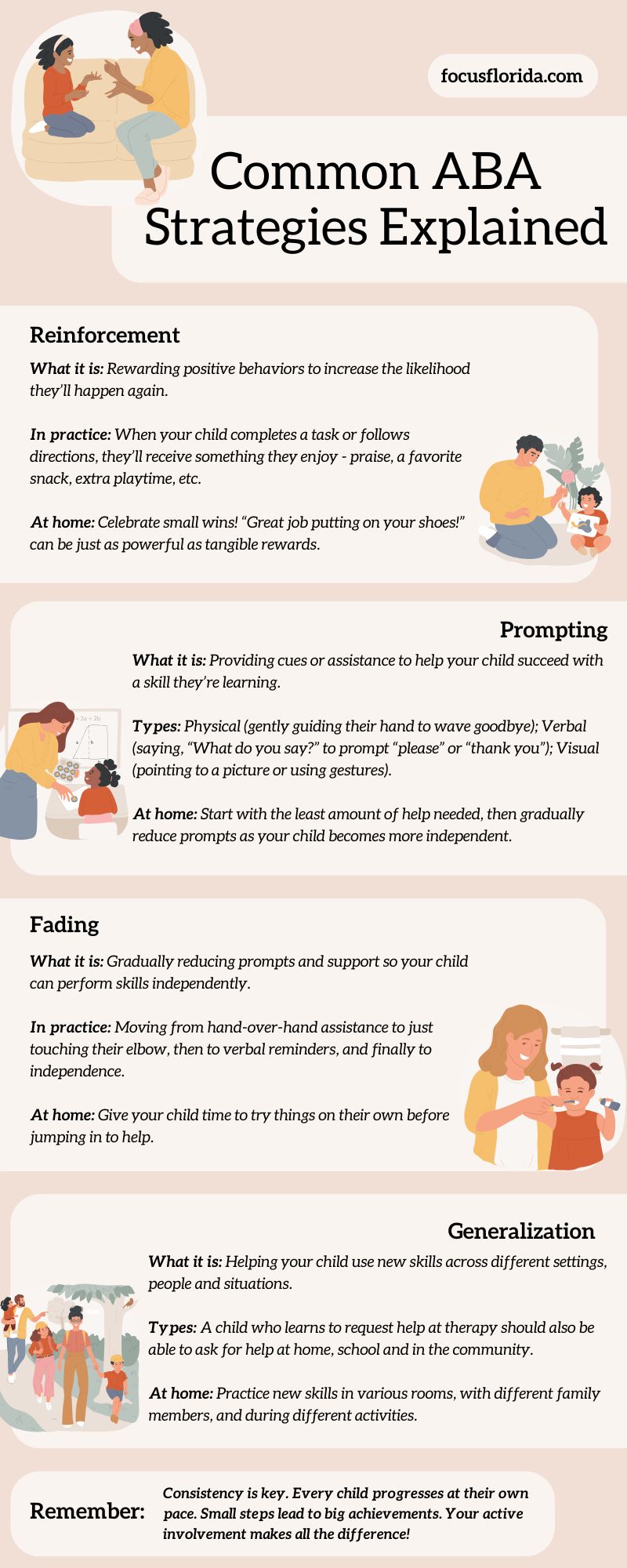
Questions about your child’s behavior therapy? The Fort Myers ABA therapy team at FOCUS is here to support you every step of the way.
FOCUS Therapy offers Fort Myers ABA therapy, occupational therapy, speech therapy, parent coaching, IEP assistance and ADOS testing in Fort Myers, Florida. Call (239) 313.5049 or Contact Us online.

Summer Sensory Activities in Fort Myers to Support Child Development
If you’re a South Florida parent, you know the drill: by 10 AM, the temperature is climbing, humidity is at sauna levels, and the “I’m bored” chorus has begun. For parents of children with developmental delays or sensory processing challenges, summer in Fort Myers presents a unique set of obstacles – but also opportunities.
At FOCUS Therapy, we recognize that some of the greatest breakthroughs in child development happen during everyday play. You don’t need expensive equipment or perfect weather to create meaningful sensory experiences to support multiple developmental areas simultaneously. Here, we offer tips on some cool summer sensory activities in Fort Myers that will keep your child engaged, learning, growing and having a blast.
Why Sensory Activities Matter for Child Development
Sensory activities aren’t just fun – they’re fundamental building blocks for development. Research published in the Journal of Child Neurology demonstrates that multisensory experiences strengthen neural pathways that support everything from motor skills to language development.
Children with developmental delays or sensory processing differences often benefit even more from structured sensory play. According to a 2023 study in Frontiers in Psychology, just 20 minutes of multisensory play daily can significantly improve:
- Fine and gross motor coordination
- Attention span and focus
- Communication skills
- Emotional regulation
- Executive functioning
Beat-the-Heat Water Activities
1. Sensory Water Table Station
Developmental benefits: Fine motor skills, tactile processing, social skills, language development
Setup: Create a water table in a shaded area using a kiddie pool or large plastic container. Rotate “themes” weekly:
- Ocean Explorer: Blue water with sea creatures, shells, and scoops
- Kitchen Chemistry: Add measuring cups, funnels, and whisks
- Rescue Mission: Freeze small toys in ice cubes that children can “rescue” using warm water, salt, or tools
Adaptation for different needs:
- For tactile sensitivity: Start with dry materials like rice or beans before introducing water
- For motor challenges: Use squeeze bottles that require different grip strengths
- For children who use mobility devices: Set up at accessible height with secure positioning
Expert tip: “Water play naturally encourages descriptive language and problem-solving,” notes a FOCUS speech therapist. “Ask open-ended questions like ‘What happens when…?’ to maximize language opportunities.”

2. Slip ‘N Slide Sensory Path
Developmental benefits: Vestibular processing, proprioception, gross motor planning, bilateral coordination
Setup: Create a shaded obstacle course using:
- A standard slip ‘n slide lined with different textured materials
- Sections of bubble wrap
- Stretches of textured mats
- Pools of water with varying depths
Research connection: A 2022 study in the American Journal of Occupational Therapy found that obstacle courses with varying sensory inputs significantly improved motor planning and body awareness in children with developmental coordination challenges.
Indoor Sensory Escapes (For Those Sweltering Afternoons)
1. DIY Sensory Bottles
Developmental benefits: Visual processing, emotional regulation, fine motor skills
Setup: Create themed sensory bottles using clear plastic bottles filled with:
- Water + blue food coloring + glitter + small ocean creatures (Ocean Calm)
- Water + baby oil + food coloring (Lava Lamp)
- Water + dish soap + food coloring (Bubble Bottle)
How it supports development: “Sensory bottles provide a calming visual input that helps regulate the nervous system,” explains an occupational therapist. “The gentle movement of materials creates a focusing effect similar to mindfulness activities.”
2. Frozen Treasure Hunt
Developmental benefits: Tactile discrimination, hand strength, problem-solving, patience
Setup:
- Fill various containers with water and small “treasures” (toys, coins, marbles)
- Freeze overnight
- Place frozen blocks in a sensory bin or bathtub
- Provide tools like spray bottles with warm water, salt shakers, and child-safe chip brushes
Adaptation for different needs:
- For children who seek proprioceptive input: Add heavier tools that require more effort
- For children with limited hand strength: Pre-score ice blocks or provide warmer water
- For children who need success: Hide treasures near the surface for easier access
South Florida Special: Twilight Sensory Adventures
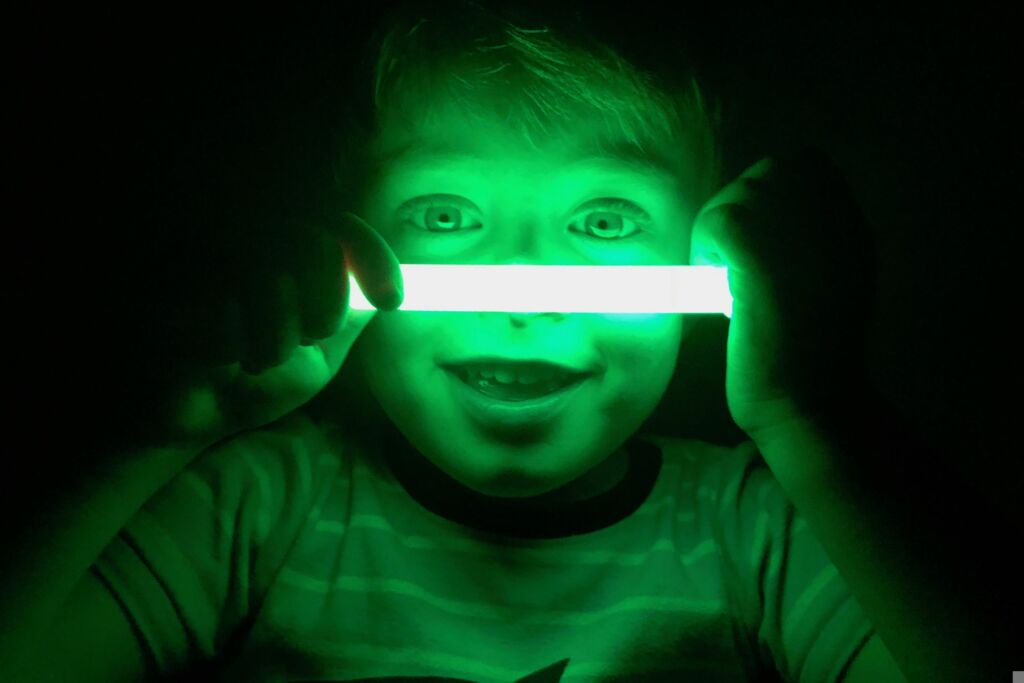
1. Glow-in-the-Dark Sensory Hunt
Developmental benefits: Visual discrimination, motor planning, spatial awareness
Setup: Wait until the sun starts setting, then head outside with:
- Glow sticks in various colors
- Glow-in-the-dark paint on paper plates as “stepping stones”
- Flashlights with colored cellophane covers
Game variations:
- “Color match” – Find objects that match each glow stick color
- “Sensory path” – Follow the glowing stepping stones while maintaining different body positions
- “Shadow explorers” – Create and identify shadows on a sheet or wall
2. Nighttime Water Play
Developmental benefits: Sensory integration, body awareness, coordination
Setup: As the temperature drops slightly in the evening:
- Set up a sprinkler with glow sticks attached
- Place LED lights in water balloons
- Create glowing water beads stations
Research highlight: A 2023 study in Physical & Occupational Therapy in Pediatrics demonstrated that rhythmic, multi-sensory activities in the evening help prepare children with sensory processing differences for better sleep quality and duration.
Edible Sensory Play (No Heat Required!)
1. Frozen Yogurt Sensory Painting
Developmental benefits: Tactile processing, creativity, fine motor skills, oral motor exploration
Setup:
- Mix plain yogurt with food coloring and freeze in ice cube trays
- Provide paper, brushes, and popsicle sticks
- Let children paint with the melting yogurt cubes
- Safe to taste as they create!
Therapist insight: “Edible sensory play is particularly valuable for children with oral aversions or those who still explore with their mouths,” notes our feeding therapy team. “It creates a no-pressure opportunity to interact with new textures.”
2. Tropical Fruit Sensory Exploration
Developmental benefits: Oral sensory processing, fine motor skills, cognitive development
Setup: Create a tasting station with:
- Fruits with varied textures (mango, kiwi, dragon fruit, papaya)
- Cutting tools appropriate for your child’s skill level
- Descriptive word cards (“bumpy,” “slimy,” “sweet”)
Make it therapeutic: “Turn this into a language-rich experience by describing textures, tastes, and smells,” suggests one of our speech therapists. “This vocabulary development naturally occurs during enjoyable sensory play.”
Sensory Activities in Fort Myers for Specific Developmental Goals

For Children Working on Speech and Language:
- Ice Excavation: Hide letters or picture cards in ice blocks and have children request tools (“I want hammer”) or describe actions (“breaking ice”) to retrieve them.
- Water Balloon Communication: Fill balloons with water and place pictures inside clear ones. Children must formulate questions or sentences about the pictures before getting to splash them.
For Children Working on Fine Motor Skills:
- Water Bead Transfer: Use tweezers or tongs to move water beads between containers.
- Squirt Bottle Art: Fill spray bottles of varying resistance with diluted paint for outdoor fence art.
For Children Working on Social Skills:
- Collaborative Sand Castle: Create designated roles (water carrier, digger, decorator) that require cooperation and communication.
- Sensory Scavenger Hunt: Work in pairs to find items with specific sensory qualities (“Find something rough,” “Find something cold”).
Making it Work for Your Family
Remember that therapeutic sensory play doesn’t need to be complicated or perfect. The most effective activities are those that:
- Match your child’s current interests.
- Can be reasonably prepared given your family’s resources.
- Allow for success while providing just the right challenge.
- Can be easily modified as your child develops new skills.
When to Seek Additional Support for Your Child’s Sensory Needs
While home-based sensory activities provide valuable developmental support, they complement rather than replace the efforts of professional pediatric therapy services. Consider reaching out to FOCUS Therapy if:
- Your child shows extreme aversion to certain sensory experiences.
- Sensory sensitivities significantly impact daily activities.
- Your child struggles to engage in play with peers due to sensory or developmental differences.
- You notice regression in previously mastered skills.
South Florida summers provide unique challenges for sensory play, but with some creativity and planning, the hot months can become a time of significant developmental growth. By selecting sensory activities in Fort Myers that incorporate multiple sensory systems and developmental areas, you’re not just keeping your child entertained – you’re building neural pathways that support lasting developmental progress.
At FOCUS, we’re here to partner with you in creating a summer full of purposeful play. Our team of speech therapists, occupational therapists, and ABA therapists can provide personalized recommendations for your child’s specific developmental needs.
Additional Resources:
Effects of Play-Based Sensory Interventions on Self-Regulation in Preschoolers With Developmental Conditions: A Systematic Review, Meeks et al, August 2024, The American Journal of Occupational Therapy
More Blog Entries:
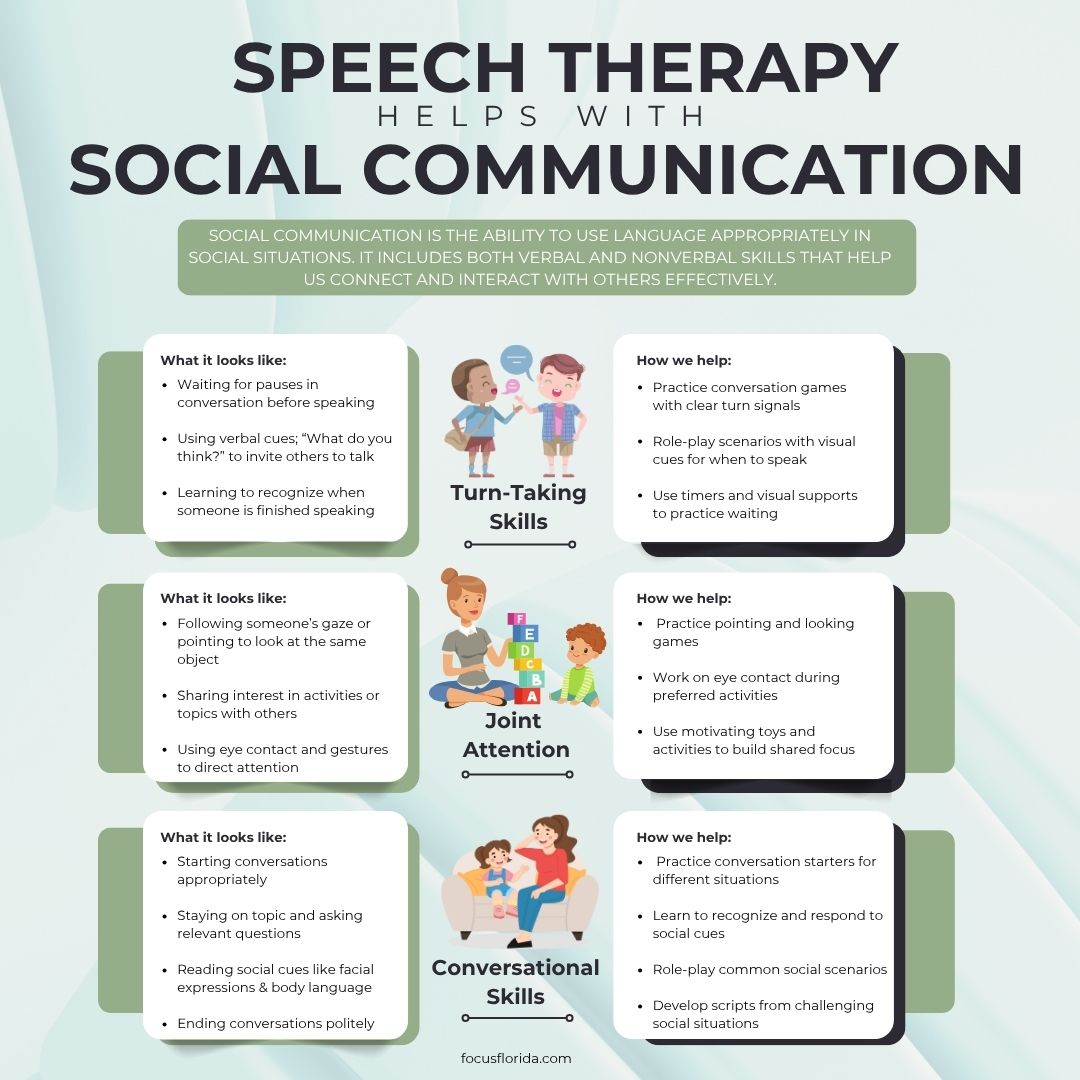
Fort Myers Speech Therapy Helps With Social Communication
FOCUS offers Fort Myers speech therapy, as well as ABA therapy, occupational therapy, and ADOS testing. Call (239) 313.5049 or Contact Us online.

Signs Your Child May Need a Speech Therapy Evaluation
FOCUS Therapy offers pediatric speech therapy at our Fort Myers clinic to families from throughout Southwest Florida, including Cape Coral, Bonita Springs, Estero, Lehigh Acres, North Fort Myers, Fort Myers Beach, and more. Call (239) 313.5049 or Contact Us online.

Language vs. Speech: Fort Myers Speech Therapists Explains Differences
FOCUS offers Fort Myers speech therapy, as well as pediatric ABA therapy, occupational therapy, and ADOS testing. Call (239) 313.5049 or Contact Us online.