
Blog

The “Publix Run” Success Guide: Using Fort Myers ABA Therapy Strategies to Turn Grocery Shopping Into a Learning Opportunity
Every parent knows that moment: You’re standing in the cereal aisle at Publix, your child is melting down because they can’t have the box with the cartoon character, and you’re wondering if you should just abandon the cart and leave. For parents of children with autism spectrum disorder (ASD) or other developmental disabilities, the grocery store can feel like navigating an obstacle course—bright lights, overwhelming sounds, countless temptations (or aversions), and the pressure to complete your shopping while managing your child’s needs.
But what if that same stressful grocery trip could become one of your child’s most valuable learning opportunities?
At FOCUS Therapy in Fort Myers, our multidisciplinary team has seen countless families transform everyday activities into powerful teaching moments using Applied Behavior Analysis (ABA) strategies. The grocery store isn’t just a place to buy food—it’s a real-world classroom where children can practice waiting, following directions, making choices, communicating needs, and so much more.
Why Grocery Shopping Matters More Than You Think
With approximately 1 in 31 children identified with autism spectrum disorder according to the CDC’s Autism and Developmental Disabilities Monitoring Network, more families than ever are seeking effective strategies to help their children navigate daily life. While it might be tempting to use delivery services or leave your child at home, these everyday outings provide irreplaceable opportunities for skill development.
The skills your child practices during a 20-minute Publix run—like waiting their turn, following a visual schedule, making appropriate requests, and tolerating sensory input—are the same skills they’ll need for success in school, social situations, and eventually, independent living. When we avoid these challenging situations, we miss opportunities to teach resilience, flexibility, and real-world problem-solving.
Our Fort Myers ABA therapy team members have worked with hundreds of families to develop strategies that make community outings not only manageable but genuinely beneficial for child development. The key is approaching these trips with intention, preparation, and evidence-based techniques.
Understanding Why Grocery Stores Are Challenging
Before we dive into solutions, it’s important to understand why grocery stores can be particularly difficult for children with autism or other developmental disabilities:
Sensory Overload: Fluorescent lights, beeping scanners, background music, announcements over the PA system, the hum of refrigerator units, and dozens of conversations happening simultaneously create a sensory environment that can be overwhelming. For children with sensory processing differences, the grocery store can feel like being bombarded from all directions.
Unpredictability: Even if you visit the same store, variables constantly change. Different cashiers, rearranged displays, out-of-stock items, varying crowd levels, and unexpected encounters (like running into a neighbor) make it difficult for children who thrive on routine and predictability.
Delayed Gratification: Children are surrounded by preferred items—cookies, chips, toys, colorful packages—but can’t have them immediately (or at all). This requires impulse control and the ability to wait, which are skills many children with developmental disabilities are still learning.
Extended Duration: Unlike a quick errand, grocery shopping often takes 20-45 minutes, requiring sustained attention, cooperation, and behavioral regulation over time.
Abstract Concepts: Following a shopping list, staying with a caregiver in a large space, understanding that we look but don’t touch, and comprehending that we pay before we eat are all abstract concepts that require explicit teaching.
Understanding these challenges allows us to address them proactively with Fort Myers ABA therapy strategies that set both parent and child up for success.

The Power of “First/Then” Boards
One of the most effective and widely-used ABA strategies for making grocery shopping successful is the “First/Then” board—a simple visual support that shows children what they need to do first and what will happen afterward.
What Is a First/Then Board?
A First/Then board is a visual schedule that breaks down expectations into manageable chunks. It typically consists of two spaces: the “First” space shows what the child needs to do, and the “Then” space shows what positive thing will happen after they complete the first task. For grocery shopping, this might look like:
First: Picture of a shopping cart
Then: Picture of a preferred snack or activity
This visual representation helps children understand the sequence of events, see that their cooperation leads to a positive outcome, and have a concrete reminder of expectations when they start to struggle.
Why First/Then Boards Work
From an ABA therapy perspective in Fort Myers and everywhere else, First/Then boards leverage several evidence-based principles:
Visual Processing Strengths: Many children with autism are stronger visual learners than auditory learners. Seeing the expectation is often more effective than hearing it repeatedly.
Concrete Reinforcement: The board makes abstract concepts like “if you do this, then you get that” visible and tangible. Children can see their progress and the reward ahead.
Reduces Anxiety: Knowing what comes next helps children feel more secure and in control. The visual support answers the question “how much longer?” that many children struggle with.
Consistent Communication: The board says the same thing every time, eliminating confusion from different adults using different words or tone of voice.
Promotes Independence: Over time, children can reference the board themselves rather than needing constant verbal reminders.
Creating Your First Grocery Store First/Then Board
Creating an effective First/Then board for grocery shopping is simple and can be customized to your child’s needs:
Step 1: Choose Your Format
You can create a board using a small laminated piece of cardboard, a photo album sleeve, a tablet with a visual schedule app, or even just a piece of paper in a plastic sheet protector. The key is making it portable and durable enough to survive your shopping trip.
Step 2: Select Appropriate Images
Use photos, simple drawings, or downloaded pictures that your child can easily recognize. For the “First” side, you might include:
- A photo of your actual grocery store
- A picture of a shopping cart
- Your child’s photo with the cart
- A picture of items on your list
For the “Then” side, include something genuinely motivating:
- A preferred snack they’ll get during or after shopping
- A favorite activity afterward (playground, tablet time, etc.)
- A special treat from the bakery
- Time with a preferred toy when you get home
Step 3: Introduce the Board Before You Leave
Don’t wait until you’re in the parking lot. Show your child the board at home, review what will happen, and let them practice pointing to “First” and “Then.” You might even role-play the shopping trip with toy carts at home.
Step 4: Reference It Throughout the Trip
The board isn’t a one-time show. Keep it accessible—clipped to the cart, in your pocket, or in your child’s hands—and reference it proactively. Before potential challenges (passing the toy aisle, waiting in line), point to the “First” expectation and remind them of the “Then” reward.
Step 5: Deliver the Promised Reward
This is crucial. If the board says they’ll get a cookie from the bakery after shopping, they must receive it. Consistency builds trust in the system and motivation to cooperate next time.
Advanced First/Then Strategies
As your child becomes successful with basic First/Then boards, Fort Myers ABA therapy providers like FOCUS Therapy can help you develop more sophisticated visual supports:
Multiple Steps: Progress to a full visual schedule showing 4-6 steps of the shopping trip (enter store → get cart → shop for vegetables → shop for milk → check out → go home).
Choice Boards: Offer choices within the shopping trip—”First we shop, then you choose: cookie OR crackers.”
Incorporating Task Analysis: Break down specific behaviors like “push cart nicely” into smaller steps (hands on cart, walk slowly, stay with mom, stop when mom stops).
Token Boards: Combine the First/Then concept with earning tokens for cooperation throughout the trip, with a larger reward after collecting all tokens.
Self-Monitoring: Teach older children to move their own picture along the schedule or check off completed steps, promoting independence.
Additional ABA Strategies for Grocery Shopping Success

While First/Then boards are powerful, a comprehensive Fort Myers ABA therapy approach to grocery shopping includes multiple evidence-based strategies:
1. Strategic Timing and Preparation
Choose Off-Peak Hours: Your first several trips should be when stores are quieter—early morning or weekday afternoons. Less crowded environments reduce sensory demands and allow more space for teaching.
Start Small: Don’t attempt a full week’s shopping on your first trip. Go in for 2-3 items and leave successfully. Gradually increase duration and complexity as your child builds skills and confidence.
Preview the Experience: Use pictures, videos, or even a drive-by of the store to prepare your child. Some families take pictures of different store sections to create a visual map.
Practice at Home: Set up pretend grocery shopping scenarios with toy food and carts. Role-play the entire sequence, including walking past preferred items without grabbing them.
Prime for Success: Ensure your child isn’t hungry, tired, or already dysregulated before attempting a grocery trip. A child who’s already struggling won’t suddenly improve in a challenging environment.
2. Clear, Specific Expectations
In ABA therapy, ambiguous expectations lead to confusion and behavior challenges. Replace vague requests like “be good” with specific, observable behaviors:
- “Keep your hands on the cart”
- “Use your walking feet”
- “Stay next to Mommy”
- “Look with your eyes, not your hands”
- “Use your words if you need help”
Give these expectations before entering the store and provide frequent positive reinforcement when you see them occurring.
3. High-Quality Reinforcement
The “Then” part of your First/Then board should be genuinely motivating. In Fort Myers ABA therapy sessions, we carefully select reinforcers that are powerful enough to motivate cooperation through challenges. For grocery shopping, effective reinforcers might include:
- Immediate access to a preferred snack (given during shopping or immediately after)
- Extra tablet time after you get home
- A trip to a favorite location after shopping (park, library, etc.)
- Special one-on-one time with a parent
- Earning pieces of a preferred toy over multiple successful trips
Critically, the reinforcer should be something your child doesn’t have constant access to at other times. If they can play with their tablet all day anyway, it won’t be motivating in this context.
4. Active Engagement and Jobs
Children often struggle in grocery stores because they’re bored and passive. Creating active participation changes the dynamic entirely:
Assign Specific Jobs:
- Putting items in the cart (hand them each item to place)
- Holding the shopping list or visual schedule
- Pushing the cart (if safe) or steering with you
- Crossing items off the list
- Counting items as you place them in the cart
- Choosing between two acceptable options
Make It Educational:
- Practice colors: “Find the red apples”
- Practice counting: “We need four bananas”
- Practice following directions: “Can you put the milk in the cart?”
- Practice making requests: “Tell me what we need next”
When children are actively participating, they have less opportunity and motivation for challenging behaviors.
5. Planned Breaks and Regulation Strategies
Even with perfect preparation, some children will need breaks during shopping trips. Build these into your plan rather than waiting for a meltdown:
- Visit the floral section for a calming sensory break (smelling flowers)
- Take a walk around the perimeter of the store if your child needs movement
- Practice deep breathing exercises in a quiet corner
- Use a fidget toy or chewy that your child brings from home
- Offer choices: “Do you need a break, or can you keep going?”
Fort Myers ABA therapy providers can help you develop a regulation plan specific to your child’s sensory needs and preferences.
6. Handling Requests for Items
Requests for non-preferred items or items not on the list are one of the most common challenges. Establish a consistent approach:
Option 1: Structured Choice
“We’re not buying toys today, but you can choose: cereal A or cereal B?”
Option 2: Delayed Gratification with Visual Support
Add a “wishlist” section to your visual schedule where your child can take a picture of desired items. Later, review the pictures and potentially add one to a future shopping list, teaching that “not now” doesn’t mean “never.”
Option 3: Earning System
Children can earn the opportunity to choose one item after demonstrating cooperation for the entire trip.
Option 4: Clear, Consistent “No”
“I understand you want that. The answer is no. We’re here for groceries on our list.” Then redirect immediately to the next task: “Let’s go find the bananas!”
Whatever approach you choose, consistency is key. If you give in sometimes but not others, you’re actually creating a powerful intermittent reinforcement schedule that makes the requesting behavior more persistent.
Building Toward Independence: The Long-Term Vision
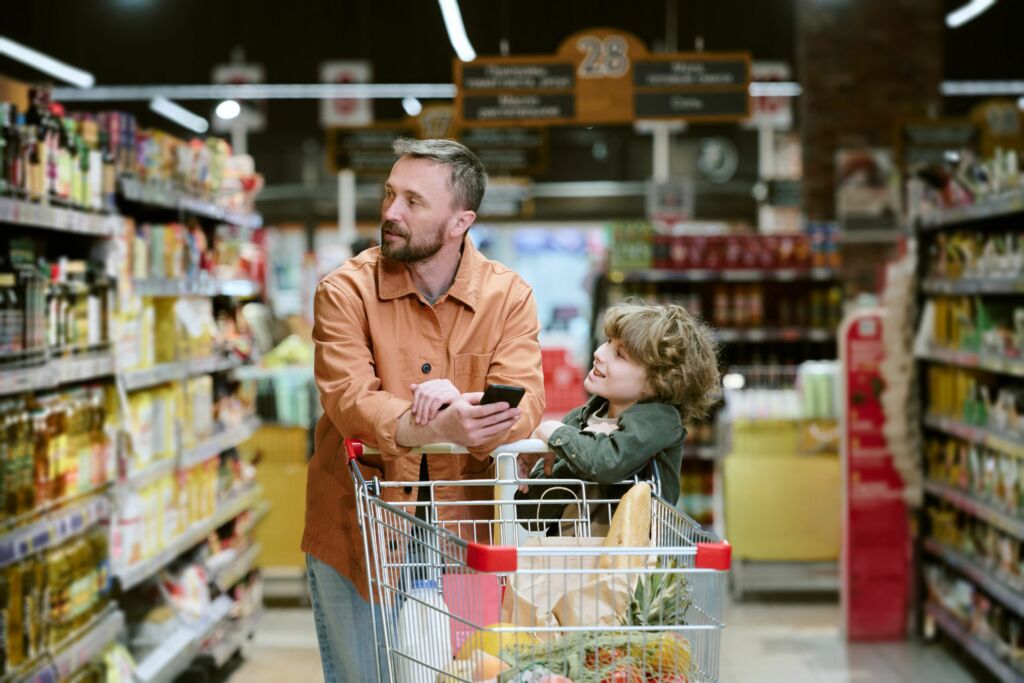
One grocery trip is just practice. The real goal of using Fort Myers ABA therapy strategies for community outings is building skills that increase your child’s independence over time.
Short-Term Goals (First Month)
- Your child tolerates being in the store for 10-15 minutes
- They can follow 1-2 simple directions during the trip
- They reference the First/Then board when reminded
- They can wait for a preferred item until checkout
- You successfully complete a shopping trip without a major meltdown
Medium-Term Goals (3-6 Months)
- Your child can shop for 30+ minutes successfully
- They independently reference their visual schedule
- They can complete specific shopping tasks (finding items, putting items in cart)
- They can request a break or express needs appropriately
- They can walk past the toy aisle without escalating
- They can wait in the checkout line with minimal support
Long-Term Goals (1+ Years)
- Your child can help create the shopping list using pictures or words
- They can navigate familiar stores with increasing independence
- They can use money concepts (helping pay, understanding cost)
- They can make appropriate choices within boundaries
- They can manage unexpected changes (out-of-stock items, long lines) with support
- They generalize these skills to other community settings
Remember, these timelines are approximate. Every child progresses at their own pace, and progress isn’t always linear. What matters is that you’re building skills systematically rather than simply surviving each trip.
When Grocery Shopping Becomes Life Skills
The beauty of using ABA strategies for grocery shopping is that the skills transfer far beyond the produce section. Consider what your child is actually learning:
Following Multi-Step Directions: Today it’s “first get the cart, then find the apples, then get milk.” Tomorrow it’s following directions in the classroom, completing homework sequences, or executing morning routines.
Delayed Gratification: Learning to wait for the cookie at the end of shopping translates to waiting for recess, waiting their turn in games, and eventually, working toward long-term goals.
Communication: Requesting items, asking for breaks, and expressing needs in the store builds communication skills that apply everywhere—at school, with peers, with future employers.
Flexibility: When the store is out of the preferred cereal, navigating that disappointment teaches flexibility and coping skills needed for all of life’s unexpected changes.
Self-Regulation: Managing sensory input, controlling impulses, and maintaining behavior over 30 minutes of shopping builds the self-regulation needed for academic success, social relationships, and independent living.
At FOCUS Therapy in Fort Myers, we see these connections daily. The child who learns to push their cart nicely is developing motor control and impulse control. The child who waits for checkout is developing executive functioning. The child who helps find items on the list is developing visual scanning, matching, and problem-solving skills.
The Multidisciplinary Advantage
While ABA strategies form the foundation of successful grocery shopping interventions, Fort Myers ABA therapy is most effective when integrated with other disciplines. At FOCUS Therapy, our multidisciplinary approach means:
Occupational Therapy input on:
- Sensory supports your child might need (noise-canceling headphones, weighted lap pad in the cart, fidgets)
- Fine and gross motor strategies for pushing carts, reaching items, opening packages
- Self-regulation techniques tailored to your child’s sensory profile
Speech-Language Pathology input on:
- Communication supports for requesting, commenting, and asking for help
- Augmentative communication if your child uses AAC devices
- Social scripts for greeting store employees or other shoppers
Behavior Analysis input on:
- Creating and fading prompts for independence
- Selecting powerful reinforcers
- Developing behavior intervention plans for specific challenges
- Data collection to monitor progress
This team approach means your grocery shopping plan isn’t just about managing behavior—it’s about developing the whole child across multiple domains.
Troubleshooting Common Challenges
Even with perfect planning, challenges arise. Here’s how Fort Myers ABA therapy principles help address common grocery shopping obstacles:
Challenge: Meltdowns at the Checkout Line
Solution: The checkout line combines multiple challenges—waiting, transition, visual access to candy and toys, and proximity to other people. Address this by:
- Using the First/Then board specifically for the checkout sequence
- Bringing a special “checkout toy” that only comes out during this time
- Teaching your child to help with checkout tasks (unloading items, scanning, bagging)
- Practicing waiting in other contexts outside of grocery stores
- Choosing a checkout lane with the shortest line initially
Challenge: Running Away or Leaving Your Side
Solution: Safety is paramount, so this needs immediate intervention:
- Use a cart strap or harness if needed for safety (prioritize safety over appearance)
- Practice “stop” and “stay with me” in less distracting environments first
- Provide constant reinforcement (every 30 seconds initially) for staying close
- Assign a job that requires staying with the cart
- Consider a visual boundary: “Stay where you can touch the cart”
Challenge: Grabbing Items Off Shelves
Solution: This is incredibly common and addressable:
- Teach “look with your eyes” as a replacement behavior
- Give your child items to hold that occupy their hands
- Practice “hands to self” with high-rate reinforcement
- Provide a sensory substitute (fidget, chewy) for the tactile seeking
- Choose aisles strategically (avoid the toy aisle until skills are stronger)
Challenge: Requesting the Same Item Repeatedly
Solution: Repetitive requests can be communicative or perseverative:
- Use a visual answer: “The answer is no. Here’s what we’re buying [show list]”
- Teach a replacement: “You can say that one time, then we move on”
- Build flexibility by practicing accepting “no” in preferred contexts
- Use a wait card: “You can ask about that again when we finish shopping”
- Ensure the “Then” portion of your board is powerful enough to compete with the requested item
Challenge: Inconsistent Success (Good Some Days, Terrible Others)
Solution: Inconsistency often reflects uncontrolled variables:
- Keep a simple log: note day of week, time, child’s state, store conditions, what worked
- Look for patterns: Is your child consistently more successful in the morning? After meals? On less crowded days?
- Adjust your approach based on data rather than guessing
- Don’t expect perfection every trip—progress isn’t linear
- Celebrate successes and treat challenging days as information
Getting Started This Week
Ready to transform your next Publix run? Here’s your action plan:
This Week:
- Create a simple First/Then board using pictures of your store and one powerful reinforcer
- Practice the board at home, showing your child what “first” and “then” mean
- Choose a 10-minute time slot at your local Publix during a quiet period
- Plan to buy just 2-3 items your child can help find
- Reference the board before entering, during the trip, and provide the promised reward
Next Week:
- Extend the trip to 15 minutes
- Add one additional expectation (new job for your child)
- Continue using the First/Then board
- Take note of what went well and what was challenging
Within a Month:
- Gradually increase duration as your child experiences success
- Add complexity to the visual schedule
- Practice problem-solving when things don’t go as planned
- Celebrate progress—even small improvements matter
Consider Professional Support: While many families can implement basic ABA strategies independently, partnering with Fort Myers ABA therapy professionals can accelerate progress and address complex challenges. At FOCUS Therapy, we can:
- Conduct functional behavior assessments to understand specific challenges
- Create individualized visual supports and behavior plans
- Coach you in real-time during community outings
- Integrate grocery shopping goals into comprehensive therapy programming
- Provide data-based decision making to refine strategies
The path from stressful grocery trips to successful community outings doesn’t happen overnight, but it does happen. With the right strategies, consistency, and support, the grocery store can transform from a place of anxiety to a place of growth.
At FOCUS Therapy in Fort Myers, our multidisciplinary team of behavior analysts, occupational therapists, speech-language pathologists, and physical therapists work collaboratively with families to develop individualized strategies for community inclusion. We don’t just want your child to tolerate the grocery store—we want them to thrive in all community settings, building toward independence and confidence.
If your family is struggling with community outings, or if you’d like to develop more sophisticated ABA strategies for your child with special needs, we invite you to connect with us. Together, we can create a plan that turns everyday activities into powerful learning opportunities, one grocery trip at a time.
Because every child deserves the opportunity to participate fully in their community. And every parent deserves support in making that possible.
FOCUS Therapy is a comprehensive pediatric therapy clinic in Fort Myers, FL, offering ABA therapy, ADOS testing, occupational therapy, speech-language therapy, and behavior consulting for parents.
Additional Resources:
More Blog Entries:
Comments are closed.