
Blog
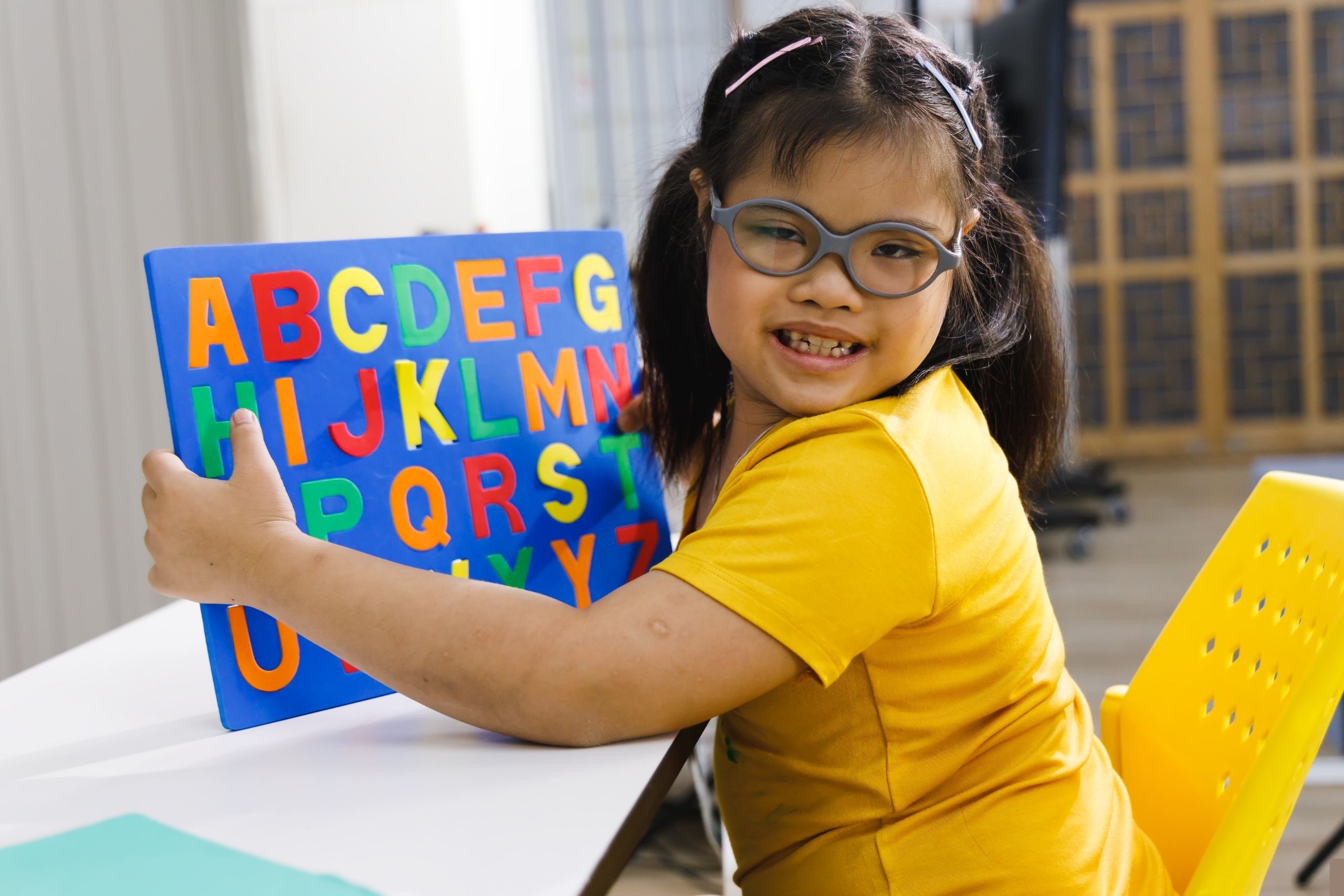
Down Syndrome and Speech: How a Fort Myers Speech Therapist Builds Communication From Infancy
A Fort Myers speech therapist for Down syndrome often meets families long before a child says a first word, and that timing is deliberate. Communication starts in the first months of life, well before speech. It starts with eye contact, cooing, turn-taking, and the first gestures. For children with Down syndrome, the foundation for talking is built in infancy. The families who start early give their children the most time to build it.
October is Down Syndrome Awareness Month, recognized each year by the National Down Syndrome Society. It is a good moment to look at what the research says about speech and language in Down syndrome, why hearing deserves special attention, and why signs and communication devices help children talk rather than holding them back.
A Common Condition With a Distinct Communication Profile
Down syndrome is the most common chromosomal condition in the United States. According to CDC estimates, about 1 in every 640 babies is born with Down syndrome, roughly 5,700 births each year.
Every child with Down syndrome is an individual. Still, researchers have documented a communication profile that shows up across many children. Babbling often begins later. And a gap tends to open between what a child understands and what a child can say. A study published in Frontiers in Psychology described the most striking finding in the research this way: children with Down syndrome often have relatively strong receptive language, the ability to understand, alongside more significant delays in expressive language, the ability to produce words and sentences.
That gap matters. A child who understands far more than he or she can say may become frustrated. Adults may also underestimate the child. Researchers writing in Language, Speech, and Hearing Services in Schools noted that poor speech intelligibility can mask what a child with Down syndrome actually knows, which can lead to serious misconceptions about overall ability. Fort Myers speech therapy for a child with Down syndrome works to close that gap, so the child can show what he or she knows.
Why Speech Is Physically Harder
Some of the expressive delay is physical. Down syndrome commonly affects the structures and muscles used for speech.
Low muscle tone, called hypotonia, affects the lips, tongue, cheeks, and jaw. Speech requires fast, precise movements from all of them. When those muscles are less firm and less coordinated, sounds come out less clearly, and it takes more effort to produce them consistently.
The mouth itself is often shaped differently. Many children with Down syndrome have a smaller oral cavity, which can make the tongue appear large and leave it less room to move. A high, narrow palate and differences in tooth development can add to the challenge. Some children also show difficulty planning and sequencing the movements of speech, which makes the same word come out differently from one attempt to the next.
These differences often show up first at feeding time. Sucking, swallowing, chewing, and moving food in the mouth draw on the same muscles and coordination that speech will later require. The American Academy of Pediatrics’ health supervision guidelines for children with Down syndrome note that infants with Down syndrome may benefit from feeding support as they develop nursing patterns. The guidelines also call for referring infants to early intervention with a speech-language pathologist. A speech therapist who addresses feeding in infancy is also laying groundwork for speech.
Hearing: The Factor Families Cannot Afford to Miss
Hearing loss is one of the most common and most overlooked contributors to speech delay in Down syndrome. The Vanderbilt Kennedy Center’s Down syndrome health watch table estimates that 50 to 80 percent of people with Down syndrome have a hearing deficit.
Much of that hearing loss is conductive, caused by fluid in the middle ear. Children with Down syndrome often have narrow ear canals and differences in the Eustachian tubes that drain the middle ear, so fluid builds up more easily and stays longer. The National Institute on Deafness and Other Communication Disorders explains that fluid behind the eardrum can muffle sound even when a child shows no signs of illness. A child learning to talk through that kind of muffled hearing receives an incomplete version of language, and the quiet sounds that carry grammar are the first to disappear.
The AAP’s guidelines set out a specific hearing schedule for children with Down syndrome. Newborns should be screened for congenital hearing loss between birth and one month. For children ages one to five who pass diagnostic hearing testing, the guidelines call for a behavioral audiogram and tympanometry every six months until normal hearing is established in both ears by ear-specific testing, usually after age four. After that, children should have hearing tests every year.
Families should keep track of these appointments. Hearing changes over time, and a child who passed a hearing test last year may not hear well today. A Fort Myers speech therapist who notices that a child’s progress has stalled will often ask first when the child last had a hearing test.

Signs and AAC: A Bridge to Speech, Not a Replacement
Parents often worry that teaching signs or introducing a communication device will discourage a child from talking. Research consistently points the other way.
Signs come first for many children with Down syndrome. Gestures and simple signs rely on larger, easier movements than speech does. A child can sign “more,” “eat,” or “all done” months or even years before saying those words clearly. That early success matters. It shows the child that communication works and reduces frustration. It also gives parents a window into what their child understands and wants. Researchers have long described manual signs as a bridge to early spoken language. As a child’s speech becomes clearer, signs typically fade naturally because spoken words become the faster option.
Augmentative and alternative communication, or AAC, extends that bridge. AAC includes picture boards, communication books, and speech-generating devices and apps. For children with Down syndrome, whose understanding often outpaces their speech, AAC gives them a way to express full thoughts while their speech catches up.
The evidence supports it. The Language, Speech, and Hearing Services in Schools researchers cited findings from Romski and colleagues showing that AAC interventions for children with Down syndrome produced greater gains in both expressive vocabulary and intelligible spoken language than spoken-language intervention alone. In that research, children who used AAC talked more clearly, not less.
FOCUS Therapy offers AAC evaluation and support as part of its speech services. That includes helping families choose a system, program it, and use it throughout the day.
What Early Speech Therapy Looks Like
Fort Myers speech therapy for an infant or toddler with Down syndrome looks like play. A therapist may work on feeding skills, imitation of sounds and facial expressions, turn-taking games, and the first signs. Much of the work involves coaching parents, because the most important language lessons happen at home, during meals, baths, and bedtime routines.
As a child grows, therapy shifts toward vocabulary, combining words, speech clarity, and social conversation. The approach changes with the child, but the principle stays the same: build on the child’s strong understanding and give him or her as many ways as possible to communicate.
Because Down syndrome affects more than speech, many children benefit from a team. FOCUS Therapy provides speech, feeding therapy, occupational therapy, and ABA therapy under one roof. That lets therapists coordinate goals for the same child, whether the goal is posture for clearer speech or fine motor skills for signing.
Start Early, Build Every Way
The research on Down syndrome and communication points to three steps families can take now. Monitor hearing on the AAP schedule. Address feeding and oral-motor skills in infancy. Use signs and AAC from the start, without waiting for speech to arrive first. Children with Down syndrome understand more than they can say. The earlier they get tools to say it, the more their speech grows alongside those tools.
FOCUS Therapy works with families of children with Down syndrome throughout Lee County and Southwest Florida. Parents who want to talk with a Fort Myers speech therapist for Down syndrome about their child’s communication can contact FOCUS Therapy to schedule an evaluation.
FOCUS Therapy offers Speech Therapy in Fort Myers, Florida. Call (239) 313-5049 or Contact Us online.
More Blogs:
Comments are closed.